






61-year-old manufacturing company reinvents itself with 3D printing
Learn how Thogus moved to a small-volume Stratasys 3D printing manufacturing process in order to compete with high-cost fabrication shops.
Related Topics
Solutions featured in this Case Study, Video
 3D Printers
 3D Printing Materials
 Digital Manufacturing Solutions
 Make Your Products
 Manufacturing Services
 Manufacturing Software
Established as Master Mold & Die in 1950 by Jack Thompson, Thogus Products (Thogus) is a 61-year-old manufacturing company rooted in injection molding. In 1997, 56% of sales came from automotive clients. A decade later, feeling the pressure of a poor economy and recognizing the threat of limited diversification, Thogus decided to search for new sources of revenue.
By the time Matt Hlavin, grandson of Jack Thompson, became president of Thogus in 2008, he had been following Stratasys – a maker of additive manufacturing machines for prototyping and producing plastic parts – for nearly 10 years. Intrigued by the product development capabilities of Stratasys technology, Hlavin had found his solution and a direction for Thogus. Hlavin decided to shift Thogus’ focus to small-volume molding and highly engineered materials using Stratasys Fused Deposition Modeling (FDM) systems. Moving to small-volume production positioned Thogus to compete with high-cost fabrication shops due to its new lean, nimble manufacturing process. “One of my first major decisions as president was to purchase two Fortus 450mc machines to aid in product development and provide more value to our clients,” recalled Hlavin. “Stratasys technology uses the same thermoplastic materials we use in injection molding, and we can produce product parts in small volumes until our clients justify the production tooling, which is very expensive.”
Finding Stratasys
Before even having his first Stratasys 3D Production System in-house, Hlavin’s vision had been validated by Stratasys: “We had ordered an FDM machine, and Stratasys agreed to make parts for us before our machine arrived. One of our clients needed a part made for a customer project, but the part could not be manufactured as designed. So, our engineers redesigned it. We then built their original part and our redesigned part and took them to the client. They were floored. When our client’s customer came in from out of the country the following week, our client was able to close the deal. Which meant we had won a $600,000 program. Before even having our machine in the building, Stratasys helped us close a program that paid for our first machine.”
Quickly realizing a return on his initial investment in two Stratasys machines, Hlavin went on to invest a few million dollars in advanced technology, capital equipment and automation, including two 3D Printers, a smoothing station and a Stratasys F900 3D Production System. “We were so confident in Stratasys, we purchased many of the FDM materials that Stratasys offers – ABSplus, ABSi, ABS-M30, PC-ABS, PC, Ultem 9085 and PPSF/PPSU – in order to handle the concept ideation, functional prototyping, prototype tooling, filtering, end of arm tooling and final production demanded by our clients,” said Hlavin.
Growth due to FDM Technology
Since 2008, Thogus has grown to 86 employees, 31 of whom were hired in 2010. In 2010, its revenue increased 76% over 2009. Thogus largely credits the drastic growth to Stratasys FDM Technology, which the company has used to develop a manufacturing solution that streamlines the production process, passing along those savings to clients. The philosophy is simple, and universal. “Low price wins,” said Hlavin. “We’ll give away parts with quotes, which is virtually unheard of for an injection molder. That’s how confident we are.”
In January 2009, Thogus didn’t have a single engineer on staff. Today, the company employs 15 engineers in the plastics, civil, mechanical, biomedical and chemical disciplines. “By bringing engineering into the business, our clients develop products faster and more efficiently,” he added. Hlavin envisions Stratasys’ FDM Technology as the future of plastics processing, manufacturing and product development. “We are at the dawn of a mass customization economy – have it your way, in small volumes.”
Related TriMech Solution
Learn more about the solutions featured in this Case Study:
More Case Studies and News Stories
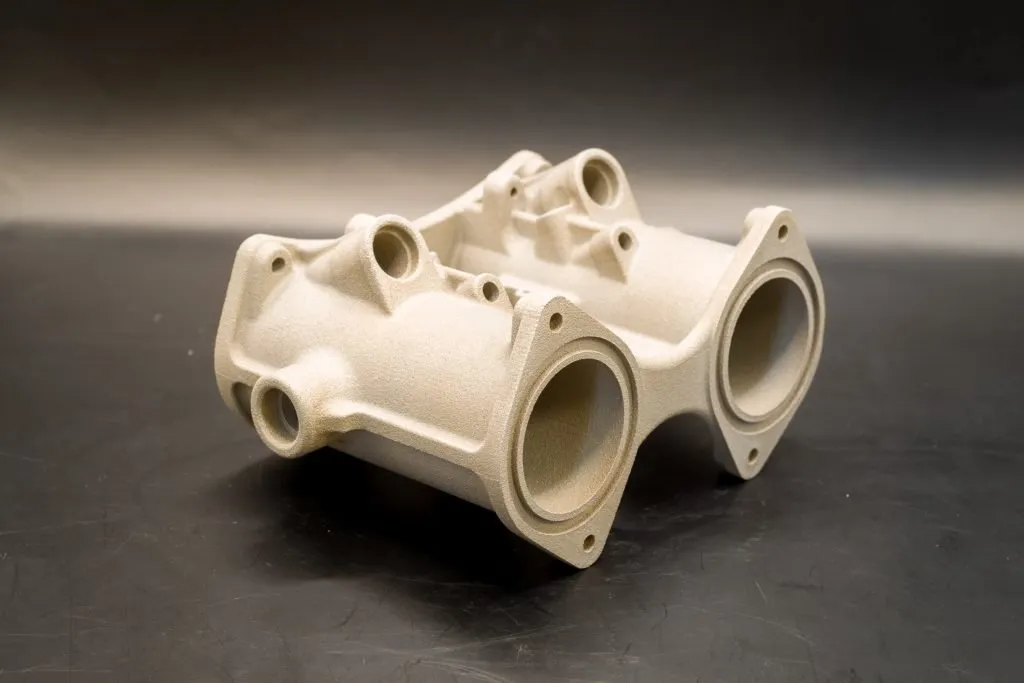
Get Affordable, High-Performance Metal Parts Quickly Using TriMech’s Cold Metal Fusion Service
TriMech now offers Cold Metal Fusion, a faster and more affordable 3D printing service for creating high-performance metal parts that outperform traditional machining and casting.

How Ford Developed the New Explorer Using Formlabs SLA and SLS 3D Printers
Learn how Ford integrated high-speed, in-house 3D printing to reduce prototyping times from days to minutes, allowing for rapid validation of complex designs for the...

How Subaru used 3D printing to cut tooling development time by 50%
Learn how Subaru of America’s Accessories Product Development team replaced expensive, outsourced tooling with in-house 3D printing, utilizing the Stratasys F770 to reduce costs by...