




 By
By For powder bed 3D printing technology, two main powder materials on the market are Nylon PA11 and PA12. But how are they different? In this article, we will explore the unique composition, mechanical properties, and applications of PA11 vs PA12.
Similarities of PA11 and PA12
Both PA11 and PA12 are used with powder bed fusion(PBF) technology such as Selective Laser Sintering (SLS). These two materials allow powder bed fusion printers to create strong, durable, and isotropic parts due to their impact and chemical resistance.
The PBF printing process works well for bulky parts such as molds, jigs, fixtures, adapters, brackets, housings, and fit and function testing prototypes. But this technology can also print with detailed resolution and both materials offer high quality, good rebound, durability, and surface finish.
Stratasys’ Selective Absorption Fusing (SAF) technology jets an infrared absorbing fluid onto a powder bed build chamber and cures it with an infrared lamp. The fluid absorbs the energy and fuses the part. This energy absorption reduces the chance of heating surrounding powder and therefore reduces the chance for warp.
Another similarity between PA11 and PA12 is that both powders can be recycled for future builds, both with 50%+ refresh rate.
PA11 vs PA12: Composition
The Nylon PA powder is a polyamide, a semi-crystalline thermoplastic. The following number is simply an indicator of how many carbon atoms are in the material composition.
PA11 powder is derived from castor oil and is 100% bio-based, making it an eco-friendly material, an outlier in 3D printing thermoplastic options. If your company has green initiatives to reduce their carbon footprint this could be an excellent option.
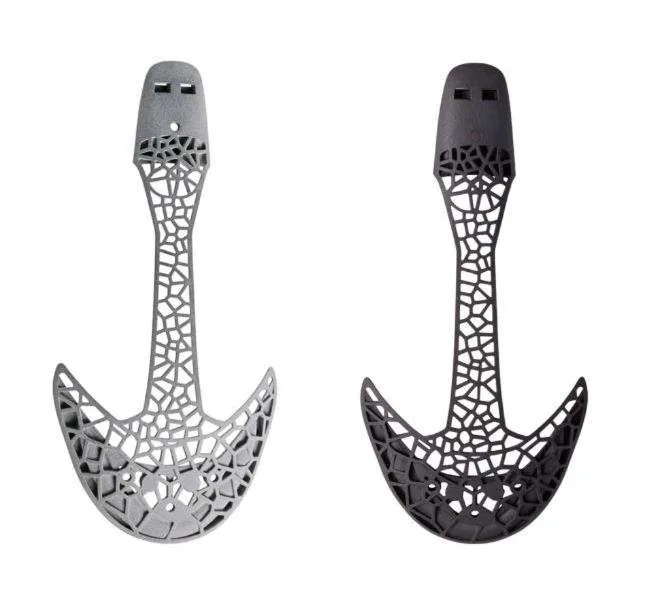
SAF Nylon PA 11
Nylon PA12 is created with petroleum. However, both PA11 and PA12 materials have the option to reclaim and recycle unused powder back into the next build.
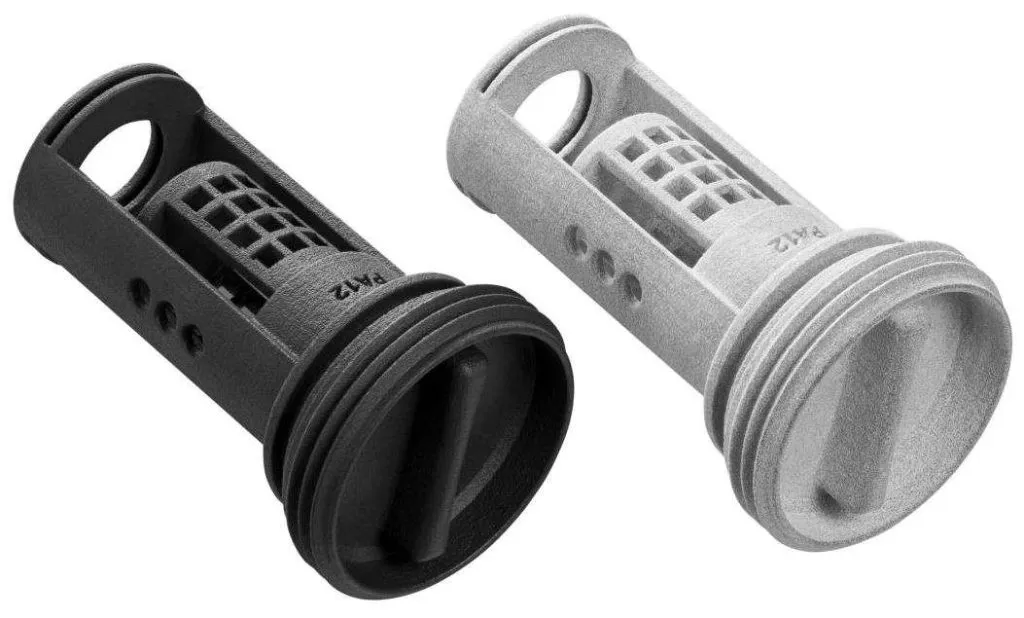
SAF Nylon PA 12
PA11 vs PA12: Mechanical Properties
To understand the mechanical properties of PA11 and PA12, here is a brief introduction:
- Tensile strength measures toughness – the stress a material can withstand while being stretched or pulled before failing or breaking.
- Tensile Modulus measures stiffness – the elastic (non-permanent) deformation of a material under stretching or compressing loads.
- Elongation at break is the changes in length (in percentage) of a material while being stretched or pulled before failing or breaking.
- Flexural Strength measures the maximum stress a material can withstanding while being bent before it fails.
- Flexural Modulus also measures stiffness – how much a material will deform elastically when bent.
- Notched Impact Strength quantifies a material’s toughness; it provides insight into how well a material can withstand sudden shocks or impacts, which is important in applications where impact resistance is critical.
Nylon PA11 has superior ductility and impact resistance. This means It can stretch and flex without losing its toughness and dissipate a lot of energy upon impact.
| Property | Mean | Standard Deviation | Unit | Standard |
|---|---|---|---|---|
| Tensile Strength (XZ,YX) | 51 (7397) | 2.2 (319) | MPa (psi) | ASTM D638-14 |
| Tensile Strength (ZX) | 47 (6817) | 4.4 (638) | MPa (psi) | ASTM D638-14 |
| Elongation at Break (XZ,YX) | 30 | 5.6 | % | ASTM D638-14 |
| Elongation at Break (ZX) | 11 | 4.8 | % | ASTM D638-14 |
| Offset Yield Strength (XZ,YX) | 35 (5076) | 1.6 (232) | MPa (psi) | ASTM D638-14 |
| Offset Yield Strength (ZX) | 34 (4931) | 2.5 (363) | MPa (psi) | ASTM D638-14 |
| Tensile Modulus (XZ,YX) | 1529 (222) | 76 (11) | MPa (ksi) | ASTM D638-14 |
| Tensile Modulus (ZX) | 1609 (233) | 99 (14) | MPa (ksi) | ASTM D638-14 |
| Flexural Strength (XZ,YX) | 35 (5033) | 2.3 (327) | MPa (psi) | ASTM D790-17 |
| Flexural Strength (ZX) | 36 (5280) | 2.9 (414) | MPa (psi) | ASTM D790-17 |
| Flexural Modulus (XZ,YX) | 826 (120) | 65 (9.5) | MPa (ksi) | ASTM D790-17 |
| Flexural Modulus (ZX) | 885 (128) | 79 (11.5) | MPa (ksi) | ASTM D790-17 |
| Notched Impact Strength (XZ,YX) | Pending | – | kJ/m (Ft.lbf/in) | ASTM D256-10 |
| Notched Impact Strength (ZX) | Pending | – | kJ/m (Ft.lbf/in ) | ASTM D256-10 |
Nylon PA12 is stiffer and can withstand temperature changes. The stiffness lends itself to reliable printing and the parts can hold up in freezing conditions.
| Property | Mean | Unit | Standard |
|---|---|---|---|
| Tensile Strength (XZ,YX) | 47 (6817) | MPa (psi) | ASTM D638-14 |
| Tensile Strength (ZX) | 46 (6672)) | MPa (psi) | ASTM D638-14 |
| Elongation at Break (XZ,YX) | 11 | % | ASTM D638-14 |
| Elongation at Break (ZX) | 5 | % | ASTM D638-14 |
| 0.2% Offset Yield Strength (XZ,YX) | 33.5 (4859) | MPa (psi) | ASTM D638-14 |
| 0.2% Offset Yield Strength (ZX) | 32.2 (4670) | MPa (psi) | ASTM D638-14 |
| Tensile Modulus (XZ,YX) | 1750 (254) | MPa (ksi) | ASTM D638-14 |
| Tensile Modulus (ZX) | 1700 (247) | MPa (ksi) | ASTM D638-14 |
| Flexural Strength (XZ,YX) | 40 (5801) | MPa (psi) | ASTM D790-17 |
| Flexural Strength (ZX) | 41 (5946) | MPa (psi) | ASTM D790-17 |
| Flexural Modulus (XZ,YX) | 900 (131) | MPa (ksi) | ASTM D790-17 |
| Flexural Modulus (ZX) | 925 (134) | MPa (ksi) | ASTM D790-17 |
| Notched Impact Strength (XZ,YX) | 4.17 (1.98) | kJ/m2 (Ft.lbf/in) | ASTM D256-10 |
| Notched Impact Strength (ZX) | 3.36 (1.60) | kJ/m2 (Ft.lbf/in) | ASTM D256-10 |
PA11 vs PA12: Applications
Nylon PA11 is typically used for demanding applications in the automotive industry and for prototypes that need to undergo long term mechanical use. Since this material offers excellent ductility, impact resistance, chemical resistance, and high elongation at break, it’s a good fit for insoles, snap closures, and living hinges.
Nylon PA12 is widely used in prototyping due to its functionality, heat resistance, and chemical resistance. Parts can be used for fit and function testing prior to moving into injection molding. Features such as snap closures living hinges can also be achieved. Its biocompatibility allows for use in prosthetics. Overall, it’s a good option for robust low-cost high-quality robust parts.
Conclusion
To conclude, Below is a brief comparison of Nylon PA11 and Nylon PA12:
| PA11 | PA12 | |
|---|---|---|
| Composite | 100% bio-based from castor oil | Made from petroleum |
| Toughness | ***** | **** |
| Stiffness | **** | ***** |
| Heat Resistance | Lower melting point that can affect processing temperature | Higher melting point for better performance in higher temp application |
| Application | Applications requiring toughness such as automotive and industrial parts | Applications where rigidity and dimensional stability are critical |

Written by Sarah Smith
Sarah Smith is a Marketing Specialist focused on Additive Manufacturing at TriMech, where she has worked since 2021. With a career spanning manufacturing and marketing, Sarah concentrates on technology applications and adoption across the industry. Based in Connecticut, she is energized by emerging technologies that help clients innovate.
Related TriMech Solution
Learn more about the solutions featured in this Article:
Need a Quote for Advanced Manufacturing?
Contact a TriMech manufacturing expert today and get answers to your questions
Related Content
More advanced manufacturing content from the TriMech team