



Melting vs Sintering in Metal 3D Printing: Key Differences and Applications

Two foundational categories in metal 3D printing, Melting, and Sintering, have significant distinctions that directly impact printed parts, material properties, and structural integrity. Metal 3D printing has revolutionized numerous industries worldwide by enabling rapid, customized part production and intricate design capabilities. Understanding these differences is crucial for applications where precision and material performance are integral in many use cases, such as production, tool making, and the medical and dental fields. Laser Powder Bed Fusion (LBPF), or Selective Laser Melting(SLM), is a leading melting powder-based technology and is particularly relevant in high-performance sectors, including aerospace, general manufacturing, and automotive, where durability, accuracy, and part strength are essential.
What is Sintering in Metal 3D Printing?
Metal printing via Sintering processes involves heating metal powders below their melting point (typically around 60-80% of it), causing particles to bond and form a cohesive structure. This process results in parts that may have a degree of porosity and typically require additional densification steps for enhanced strength. FDM (Fused Deposition Modeling) and Binder Jetting are common sintering-based methods.
Sintering Process Steps
- Powder Selection: Powders must have a consistent size and shape to ensure uniform bonding and sintering quality.
- Debinding and Sintering: Printed parts in the ‘green’ state must have their binding agent removed via a debinding step, followed by an oven sintering step in an inert gas, before the final part can be utilized.
- Density Considerations: Sintered parts often have a density between 95% and 97% of the metal’s expected value resulting in embedded or surface defects.
Technologies Utilizing Sintering:
- Fused Deposition Modeling (FDM): Typically achieves a 97-98% density, making it slightly denser than binder jetting.
- Binder Jetting: Achieves densities in the range of 95-97%, slightly lower than FDM.
Advantages of Sintering
- Efficiency: Suitable for complex parts with moderate strength requirements.
- Material Options: Compatible with various alloys, including stainless steel, aluminum, and titanium alloys.
- Speed: Sintering methods work quicker due to thicker layer heights than melting technologies, the ability to print support-free, and sintering of many parts all at once in large ovens for mass production.
Disadvantages of Sintering
- Porosity: Sintered parts contain significant porosity, leading to lower density and weaker parts.
- Inconsistent Quality: Variability in powder quality can lead to inconsistencies in part density and strength.
What is Melting in Metal 3D Printing?
In contrast to sintering, melting techniques fully liquify metal powder particles using high-energy sources like lasers or electron beams to create dense, robust parts. Laser Powder Bed Fusion (LBPF) is the primary melting technology in Metal 3D Printing that’s been in the industry for 20 years, and it is ideal for applications demanding exceptional part strength and detailed geometries.
The LBPF Process:
- Powder Supply: Metal powder is added onto the feed piston.
- Coating: A coater distributes a uniform powder layer on the build platform, typically around 40 microns thick.
- Fusing: A high-powered laser selectively melts the powder according to the CAD design, creating a homogenous crystalline layer.
- Lowering the Build Plate: After each layer is fused, the build plate lowers, allowing the process to repeat until the part is complete.

LBPF Printed Part
Melting Process Details:
- Powder Reflectivity: Metal powder particles’ reflectivity can add to the challenge of proper absorption for melting – but also can help ensure unexposed particles deeper in a layer can melt without direct laser exposure.
- Melt Trace Strategy: Reduces heat accumulation, preventing excessive grain growth and maintaining part integrity.
- Grain Structure: Rapid cooling leads to a fine, predictable microstructure to enhance strength.
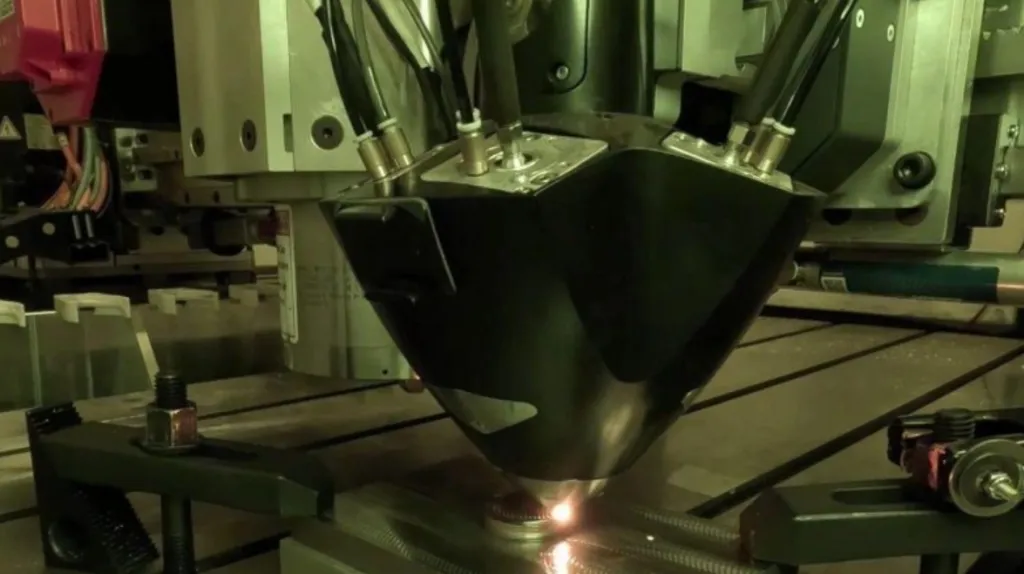
Meltio’s DED system Producing Replacement Parts
Advantages of Melting Processes
- Density and Strength: Produces dense parts with mechanical properties often exceeding that of wrought metals, suitable for high-stress applications.
- Material Compatibility: Supports a wide range of alloys, including 316 Stainless Steel, 17-4 PH Stainless Steel, Maraging 300 (tool steel), biocompatible Ti64 Grade 23 titanium, AlSi10Mg cast aluminum, Cobalt-Chromium, 6061 aluminum, Inconel 718, and Inconel 625.
- Precision and Detail: It achieves high resolution with layer thicknesses as fine as 20 microns, resulting in excellent surface finish and intricate details.
- Post-Processing Efficiency: Supports are more accessible to remove, and build boxes enable rapid transitions to new prints, enhancing overall efficiency.
Disadvantages of Melting:
- Cost: LBPF systems can be more expensive than sintering methods.
- Speed: Slower production times due to low layer heights and control required for part integrity.
- Support Structures: Supports are required and made of the same material as the printed model. These can be troublesome to remove if not considered during print setup.
Key Comparisons: Melting vs Sintering in Metal 3D Printing
Feature | Sintering | Melting (LBPF) |
Material Bonding | Bonds powders below melting point; highly porous | Fully melted; dense, homogenous structure |
Density Range | 95-97% (Binder Jetting), 97-98% (FDM) | >98% |
Strength | Moderate | High, often exceeding wrought parts |
Post-Processing Needs | Debinding and sintering are required, HIP advised | Support removal, sometimes annealing |
Part Applications | Mass production of low strength metal parts | High-strength, load bearing, precision parts, certifiable parts |
Material Bonding and Part Quality
- Sintering: Bonds powder at lower temperatures, resulting in a porous structure that often requires post-processing densification. Ideal for parts with moderate strength requirements or complex geometries. Metal sintering methods work quicker than metal melting technologies due to thicker layer heights, lack of support structures, and use of large ovens to sinter many parts at once
- Melting (LBPF): Fully liquefies metal, producing dense parts with superior mechanical properties. LBPF provides high-quality parts suitable for high-stress applications with meticulous control over part integrity. Not ideal for mass production of cheap metal parts.
Density and Strength
- Sintering: Achieves densities of 95-97%, which is sufficient for many applications but will result in inherent weaknesses via embedded and/or surface defects
- Melting (LBPF): Achieves densities above 98%, resulting in parts with mechanical properties meeting or exceeding that of wrought metals, making them highly durable and strong.
Post-Processing Needs
- Sintering: Typically requires additional processes like Hot Isostatic Pressing (HIP) to strengthen and densify parts.
- Melting (LBPF): Involves support removal, which can take about 20 minutes, followed by machining or surface finishing or the use of a Dremel.
Powder Fabrication and Handling in Metal 3D Printing
The quality of the powder used in 3D printing significantly influences the part quality. Metal printing requires spherical particles that flow evenly across the build platform for consistent, dense layering. Common powder production methods for both Sintering and Melting include:
Gas Atomization: The most common method. Liquid metal is sprayed with high-pressure inert gas, producing spherical particles. This is the most widely used method due to its efficiency and ability to produce high-quality powders balanced with low operational cost.
Rotary Atomization: Metal is poured onto a rapidly spinning plate, generating particles through centrifugal force.
Plasma Atomization: Uses high-energy plasma torches to make metal wire explode into powder. Though costly, it is highly effective for producing uniformly spherical particles for high-performance parts.
Plasma Rotating Electrode Process (PREP): Involves rotating a metal rod at high speeds within a plasma field, causing it to atomize into powder. This expensive process also excels in creating fine, uniform particles.
Water Atomization: Utilizes water jets to spray molten metal into powder like gas atomization.
Powder Handling Considerations
- LBPF Systems: Require powders with uniform diameter and near-perfect spherical shapes to ensure even flow and consistent layering. Powders are sieved after each print to remove contaminants like spatter/ejecta particles, which can affect printing consistency.
- Binder Jetting: Powders cannot be reused because they contain residual binders, as even a tiny amount of binding agent can interfere with bonding in new layers. This makes powder handling and material management even more critical in binder jetting compared to LBPF.
Technologies Utilizing Sintering and Melting: A Marketplace Overview
Sintering Technologies
In the sintering space, companies like Desktop Metal, HP, Markforged, and Ultimaker conduct technologies suited for prototyping and moderate-strength applications. While these solutions overlook binder jetting and sintering markets, One Click Metal distinguishes itself in the melting arena with its efficient, user-friendly Laser Powder Bed Fusion (LBPF) systems. Focusing on producing dense, high-strength parts, One Click Metal addresses industries where high-level durability and precision are paramount, offering a compelling alternative to sintering technologies.
Melting Technologies
One Click Metal (Laser Bed Powder Fusion):
One Click Metal’s LBPF technology uses a 200W laser and achieves excellent material compatibility. OCM’s systems are recognized for their efficiency and are beneficial in education, automotive, and job shops. They produce high-quality metal parts with precision, typically on smaller-sized parts, especially for parts with intricate details. With a cartridge-based powder delivery mechanism, the powder management system enhances usability, increases safety in powder handling, and reduces waste for proper powder management. OCM’s LBPF produces layers as fine as 20 microns, contributing to excellent resolution and surface finish. The MPRINT system starts at $190K; the MPUREpro power station starts at $49K.

OCM – BOLDSERIES – MPUREpro

OCM – BOLDSERIES – MPRINT
Meltio (Directed Energy Deposition):
Melito’s Directed Energy Deposition (DED) technology uses six lasers to melt metal wire, making it ideal for producing large metal parts and complex 3D geometries without metal powder safety concerns. With layer heights ranging from 0.6 mm (23.6 thousandths of an inch) up to 1.2 mm (47 thousandths of an inch), DED suits industries requiring extensive build volumes, reduced support structures, and parts that benefit from large scale and durability. This is often referred to as the “FDM of Metal Printing,” offering greater flexibility in design and accommodating larger applications, such as in aerospace and heavy machinery.
Choosing the Right Technology
1. Application Requirements:
- High-Density, High-Strength Parts: Melting (LBPF) is preferable for applications requiring exceptional strength and durability.
- Complex Geometries with Moderate Strength: Sintering methods like FDM or Binder Jetting are suitable for producing intricate parts without needing total density.
2. Budget and Material Costs:
- Melting Technologies: More expensive upfront but yields durable, certifiably high-quality parts.
- Sintering Technologies: More cost-effective for budget-sensitive projects with less stringent performance requirements.
3. Post-Processing Requirements:
- Melting: Involves support removal and surface finishing but has shorter post-processing times.
- Sintering: Often requires additional densification steps like HIP to achieve desired strength and density. Debinding and sintering takes several hours.
4. Material Availability:
- Melting (LBPF): Supports a wide range of high-performance alloys with futureproofed potential.
- Sintering: Compatible with various alloys but may have limitations based on the specific sintering technology used.
5. Ease of Use:
One Click Metal’s LPBF systems are designed with user-friendliness in mind, making them an excellent choice for individuals who may not have extensive engineering or technical experience. Similarly, Meltio’s DED systems stand out for their quick setup process and machine turnover. They are particularly well-suited for beginners in metal 3D printing who want to produce large parts quickly. On the other hand, many different metal 3D printing systems can be more complex to operate, often requiring significant expertise and specialized training to ensure they are used effectively and safely. This distinction highlights the accessibility and versatility of One Click Metal and Meltio systems compared to more advanced setups.
Conclusion
The debate of Melting vs Sintering in Metal 3D Printing reveals unique advantages to each, but the best choice depends on your project’s specific requirements regarding strength, density, design complexity, budget, and post-processing capabilities.
Sintering is ideal for efficiently and cost-effectively producing complex parts with mild strength needs. Melting is the go-to choice for high-strength, high-density parts requiring exceptional mechanical properties and detailed geometries. By understanding these foundational differences, engineers and manufacturers can make informed decisions to optimize their metal 3D printing processes, ensuring success in their respective industries.
Related TriMech Solution
Learn more about the solutions featured in this Article:
Need a Quote for Advanced Manufacturing?
Contact a TriMech manufacturing expert today and get answers to your questions
Related Content
More advanced manufacturing content from the TriMech team