






SAF Technology Increases Efficiency of Rivelin Robotics Post-Processing Systems
Learn how Rivelin Robotics harnessed the power of the Stratasys H350, to create SAF parts quickly and efficiently.
Related Topics
Solutions featured in this Case Study
 3D Printers
 3D Printing Materials
 Digital Manufacturing Solutions
 Make Your Products
 Manufacturing Services
 Manufacturing Software
Based out of Sheffield, England, Rivelin Robotics specializes in metal additive manufacturing (AM) support removal and finishing. Specifically, the Rivelin Netshape® robots simplify, automate, and expedite post-processing in near-net-shape metal manufacturing.
“SAF™ technology allowed us to prototype, test, and iterate quickly so that we were fully confident in our product and how it would perform.” -Robert Bush, CEO of Rivelin Robotics”
According to Robert Bush, CEO of Rivelin Robotics: “At Rivelin we are developing solutions for post-processing metal AM parts. When off-the-shelf electrical components were not available to meet our needs, the talent and drive of the Rivelin team were deployed to develop an electrical connector that would. The SAF AM process and the materials it can utilize were a great match for our application both in terms of product development and production. It allowed us to prototype, test, and iterate quickly so that we were fully confident in our product and how it would perform.”
The missing link
Post-processing can pose a significant challenge as parts often have complex geometries. To overcome this, a variety of tools are required. To enable the use of multiple tools on a single robot arm, a tool changer is used on the end of the robot. Although the robot is small in size, the tools have higher than usual electrical demands, both in terms of current and total pin count. Based on these specifications, Rivelin Robotics struggled to find an off-the-shelf solution that could address both needs.

Rivelin Connector Installed
Connector iterations
With this in mind, Rivelin Robotics was determined to produce the solution they required and designed their first version of the electrical connector. Originally printed with a low-end FFF system, the connector worked well for a period of time. Unfortunately, the connector’s design required extra sealing to improve its IP rating. It also required an upgrade for additional current carrying capacity. Finally, this first design was difficult to maintain. Without a working connector, Rivelin’s robots could no longer run. This delayed customers and Rivelin couldn’t further their technology or designs. To address this issue, a new connector was required which was both easier to use and manufacture.

Rivelin Connector internal circuit board
The solution
With the design freedom afforded by powder bed-based polymer processes, Rivelin Robotics landed on the H350™ 3D printer utilizing SAF technology. The second version of the connector, printed with SAF technology, offers a more modular and flexible approach. This connector is an electrical “plug” which enables the tool changer connector to pass data and power to the tool on the other end.

Stratasys H350
Designing and printing the connector
To perfect the connector, rapid prototyping was performed. This resulted in three separate batches with four complete sets for the robot and 50 sets for the tools. The build consisted of 360 parts, printed in only 12 hours. The connector was printed with SAF PA12 which creates precise and stiff parts.
Benefits and properties of the connector
This second version of the connector includes a separate, flexible, and integrated strain relief for the cable as the robot moves. This complex geometry was printed directly onto the connector body in a single piece utilizing SAF technology.
Although both High Yield PA11 and PA12 are suitable for connectors, SAF™ PA12 was applicable in this specific instance as it exhibits improved stiffness and accuracy. In comparison, PA11 has excellent impact toughness and ductility for applications that experience more dynamic loads. In the previous version of the connector, it was difficult to achieve thin walls. The O-ring groove sizing was also a challenge since the rings became slightly over-compressed. The SAF version enables a tight fit of connector housings, ensuring that the O-ring seals are perfectly aligned to maintain the IP rating of the assembly.
It is vital that the connector can be utilized on various tools and withstand high currents. Each high current power pin can take up to ten amps. The lower current data pins are able to reliably pass an amp each. This is possible thanks to SAF technology’s ability to manufacture tight tolerances. Each data pin is aligned correctly as individual pins are each inserted through a small hole. This intricacy reinforces a robust electrical connection.
Dimensional repeatability is also key, with multiple sets of connectors being printed in the same build. SAF is able to provide interchangeable parts, ensuring that the pins on the two halves of the connector always fit together regardless of where they are printed. Epoxy potting compound is added to the connector after assembly, making it completely waterproof. This further protects the robot’s systems and enables the connector to resist any dust exposure.
-

- Rivelin Face Plate
-

- Rivelin Connectors Pair
“The ability to rapidly iterate a second version with a slightly deeper groove is what makes additive manufacturing hugely valuable over injection molded or machined parts.”
— David Mason, Chief Product Officer at Rivelin Robotics
-

- Rivelin Connectors Mated
-

- Rivelin Robotics connectors
The future for Rivelin Robotics
After implementing the connector in all of their robots, the tool changer can now effectively transfer power and data to the connected tool. This streamlines post-processing efforts for metal manufacturing, leading to greater efficiency. Due to the connector’s ease of use and precision, it is on the bill of materials for future sales to be used as a production part. With SAF technology, Rivelin Robotics was able to print their own solution which helps shape the future of their robots and company overall.
Related TriMech Solution
Learn more about the solutions featured in this Case Study:
More Case Studies and News Stories
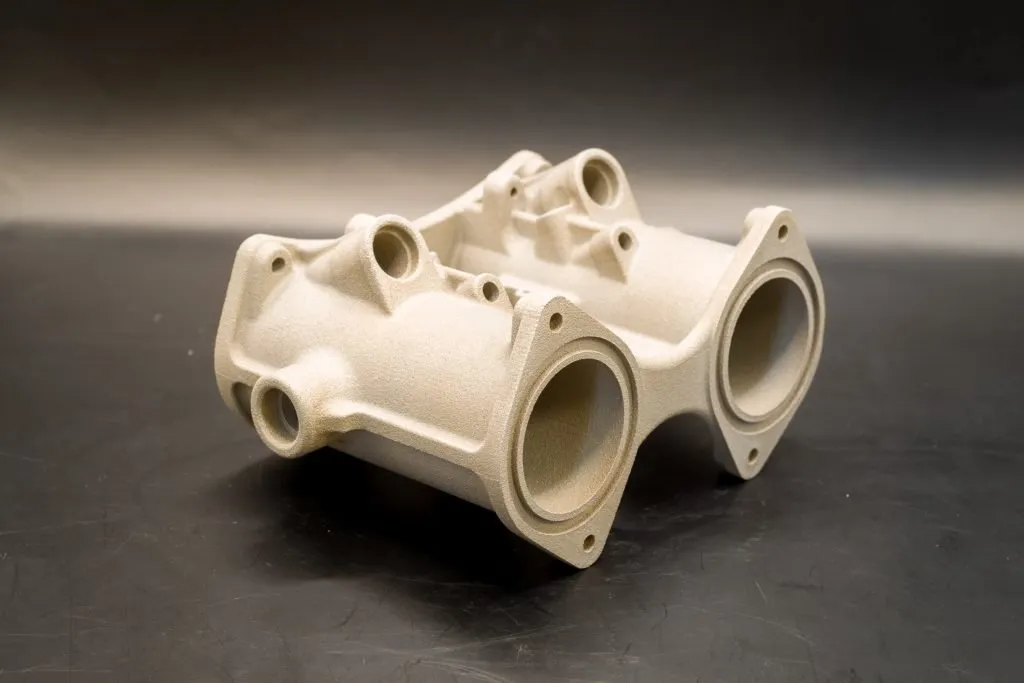
Get Affordable, High-Performance Metal Parts Quickly Using TriMech’s Cold Metal Fusion Service
TriMech now offers Cold Metal Fusion, a faster and more affordable 3D printing service for creating high-performance metal parts that outperform traditional machining and casting.

How Ford Developed the New Explorer Using Formlabs SLA and SLS 3D Printers
Learn how Ford integrated high-speed, in-house 3D printing to reduce prototyping times from days to minutes, allowing for rapid validation of complex designs for the...

How Subaru used 3D printing to cut tooling development time by 50%
Learn how Subaru of America’s Accessories Product Development team replaced expensive, outsourced tooling with in-house 3D printing, utilizing the Stratasys F770 to reduce costs by...