






Students Gain High-Demand Skills with 3D Printing at Dunwoody College of Technology
Students in Dunwoody’s Engineering Drafting & Design program use Stratasys F123 Series 3D printers to verify their design concepts.
Related Topics
Solutions featured in this Case Study, Video
 3D Printers
 3D Printing Materials
 Digital Manufacturing Solutions
 Make Your Products
 Manufacturing Services
 Manufacturing Software
Students in Dunwoody’s Engineering Drafting & Design program use Stratasys F123 Series 3D Printers to verify their design concepts.
Dunwoody College of Technology was founded in Minneapolis, Minnesota in 1914 with the vision to provide a rigorous, industry-focused technical education. As the oldest and only non-profit technical college in the region, Dunwoody has garnered an international reputation for its successful curriculum of hands-on, applied learning.
3D printing is a key part of that curriculum. Students learn critical thinking along with practical, high-demand skills. “In the last three years, there has been a huge momentum increase in 3D printing at Dunwoody and students want programs centered on it,” said E.J. Daigle, Dunwoody’s Dean of Robotics & Manufacturing.
Learning to Leverage 3D Printing
For students in the Engineering Drafting & Design program, applying these sought-after skills also involves extensive practical experience on the college’s 3D printers. “Students spend their first year learning the basics of (blue)print reading and SOLIDWORKS software,” said Alex Wong, the engineering, drafting and design instructor. “In the second year, we get into application problems and we do a lot of 3D printing where students use real-world applications to solve
design problems and create new products.”
Hands-on coursework includes weed whip and golf putter design projects that teach students manufacturing processes. Students also learn how to leverage 3D printing during the product development process by verifying concepts, validating designs and testing.

Students verify and refine their product designs with accurate, durable 3D printed prototypes.
“During the weed whip project, one team of students designed their prototype with a hand guard,” Wong said. “Their CAD model looked good, but when they 3D printed it and held it in their hand, they found it was too small and not user friendly. But with our 3D printers, they were able to make a quick design change.”
The golf putter design project, streamlined with Dunwoody’s 3D printers, pushes students to research, innovate and refine concepts within the strict parameters of the United States Golf Association.
“Without a 3D printer, the lesson would have to be executed using hand-cut wood models,” said Wong. “3D printing accelerates the lesson, focusing students on the design and engineering, rather than personal craftsmanship. And students can use more complex geometry and curves because they are not limited to what they can do with subtractive methods and hand tools.”
Refining Concepts and Shaping Futures
3D printing lets students adjust their concepts at every step of product development. This accelerates the process and teaches students how to be successful with technology that is continually advancing in speed, accuracy and reliability. But not just any printer will do. Colleges like Dunwoody look for printers that are easy to use and give professional results. Speed, reliability and economy are other important factors because the printers serve many students on a daily basis. To meet these requirements and the growing demand, Dunwoody bought a Stratasys F370™ 3D Printer. “The speed of the Stratasys F370 is a big benefit,” Wong said. “It’s intuitive to work on and the graphical 3D preview of GrabCAD Print™ helps students diagnose problem areas like thin walls and correct toolpath issues before printing.”
Related TriMech Solution
Learn more about the solutions featured in this Case Study:
More Case Studies and News Stories
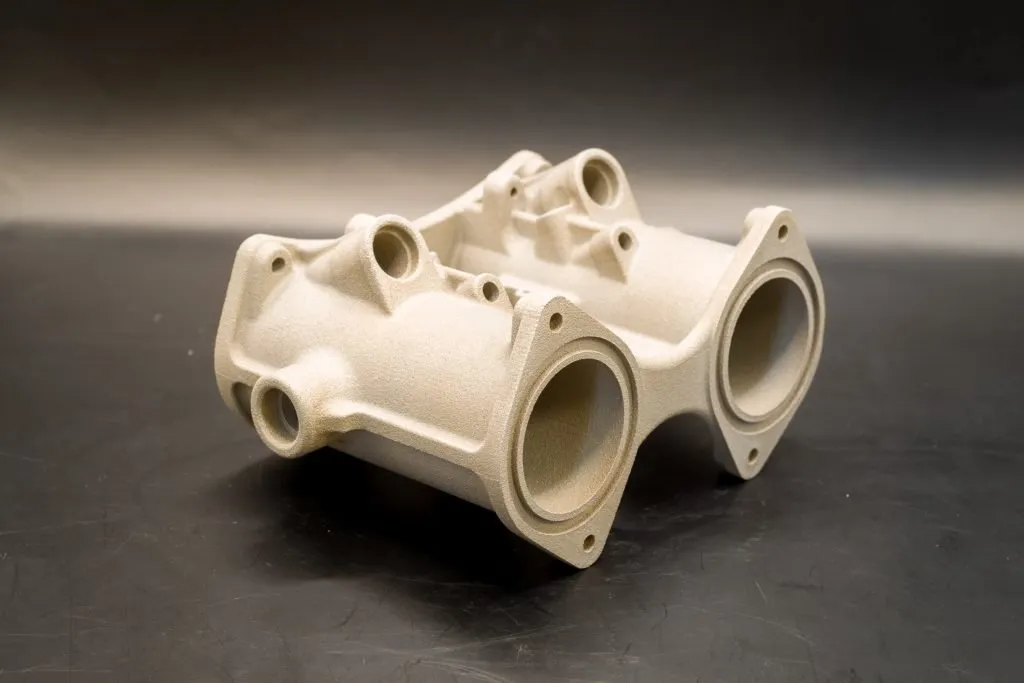
Get Affordable, High-Performance Metal Parts Quickly Using TriMech’s Cold Metal Fusion Service
TriMech now offers Cold Metal Fusion, a faster and more affordable 3D printing service for creating high-performance metal parts that outperform traditional machining and casting.

How Ford Developed the New Explorer Using Formlabs SLA and SLS 3D Printers
Learn how Ford integrated high-speed, in-house 3D printing to reduce prototyping times from days to minutes, allowing for rapid validation of complex designs for the...

How Subaru used 3D printing to cut tooling development time by 50%
Learn how Subaru of America’s Accessories Product Development team replaced expensive, outsourced tooling with in-house 3D printing, utilizing the Stratasys F770 to reduce costs by...