




 By
By Looking for solutions for your advanced prototypes? Or an option for limited production? Need production quality parts without the cost of injection molding?
Urethane casting is widely used for prototyping, short-run, bridge production before injection molding. In this guide, we will walk you through the process of urethane casting, benefits and challenges of this manufacturing process compared to injection molding and 3D printing, the best use cases, materials and finishing options of the urethane cast parts, as well as some tech tips for urethane casting.
What is Urethane Casting?
As one type of polymer casting, urethane casting is a low-volume manufacturing process used to create plastic parts by pouring liquid polyurethane resin into a mold. Because urethane casting often uses pour mold under vacuum to remove air bubbles and improve part quality, it is often called vacuum casting as well.
Simplified 3-Step Workflow of Urethane Casting
Step 1: Make the master model
At TriMech, we create the original part using 3D printing or CNC machining, to ensure the surface finishes and details are exactly what you want.

Casting Master Pattern
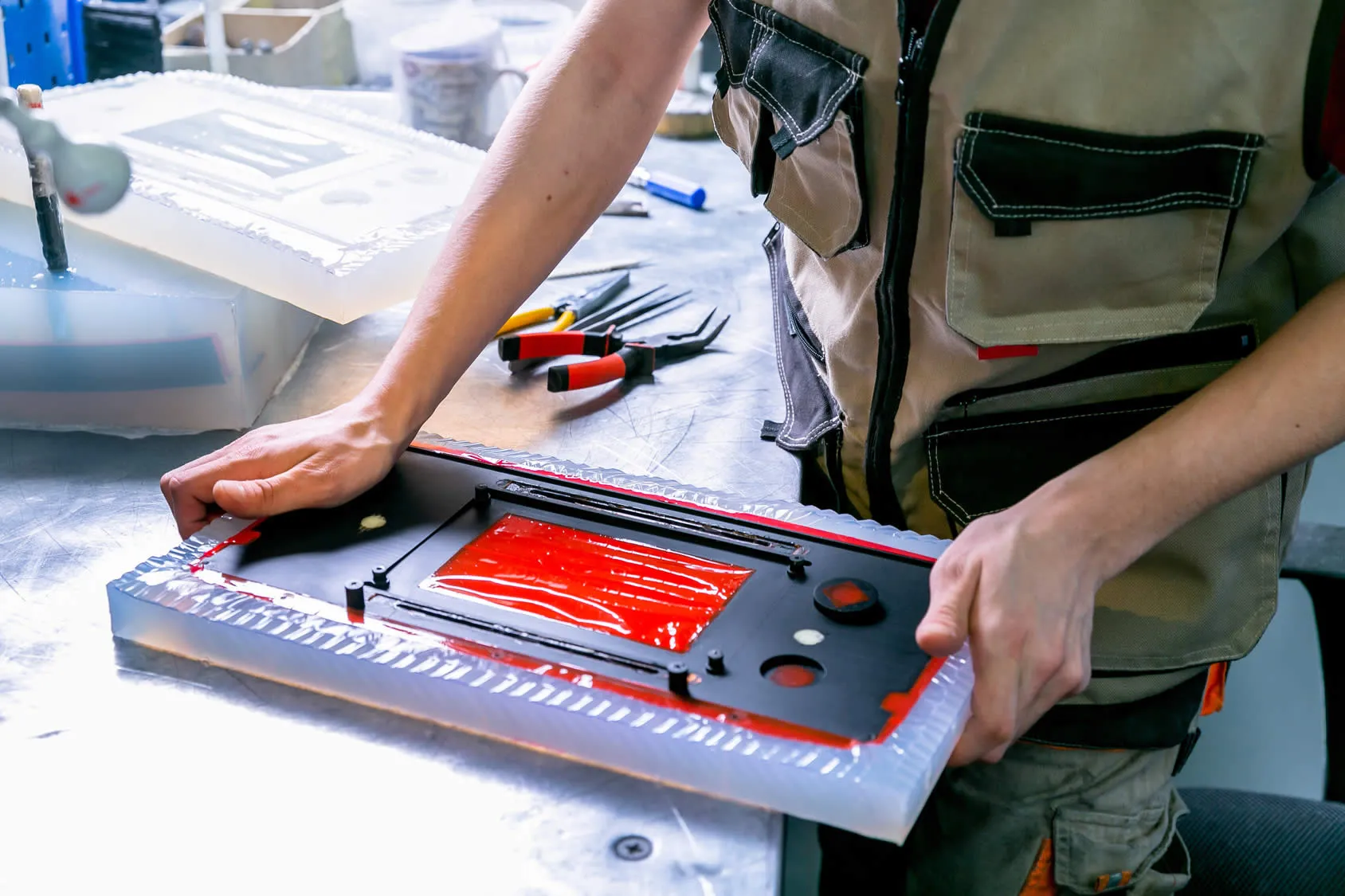
Step 2: Make the mold (RTV molding)
We place the finished master in a mold box, pour liquid RTV silicone around it, let the silicone cure (usually 6-24 hours), open the mold and remove the master.
Molded plastic part
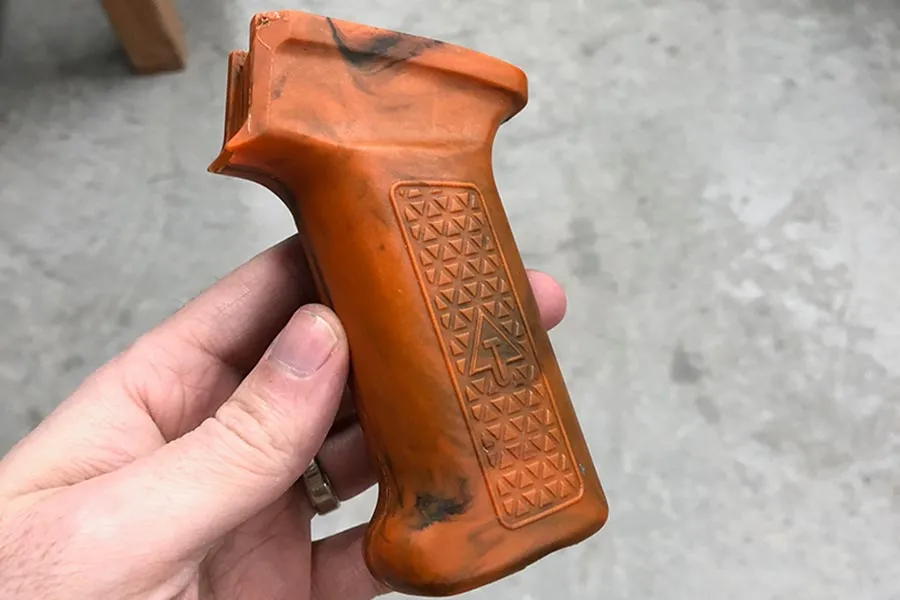
Step 3: Cast the urethane parts
With lots of material options, we’ll select the best material for your application and mix polyurethane resin and pour it into the silicone mold, let it cure (from minutes to hours, depending on the resin), then demold the part and apply finishing and secondary operations.
Urethane-Casting Part
Key Strengths of Urethane Casting
- Accurate parts with fine details and complex geometries.
- Material flexibility: thermoset polymers that simulate ABS, PP, or rubber that could be rigid, flexible, rubber-like, transparent, UV, flame, or high-temperature resistant.
- Variety of finishing options: high-gloss finish, matte finish, texture matching, abrasion-resistant coating, EMI shielding, and different color options.
- Price Point: Particularly for larger parts, cast urethane is a more competitive option, price-wise vs. 3D printing.
Limitations of Urethane Casting
- Short tool life: The mold used in urethane casting is usually made of silicone rubber, which is soft and flexible, and repeated exposure to heat and chemicals in the resin causes the mold to tear, shrink, or lose detail over time. Typically, silicone molds last for 20-50 castings, depending on the material that’s being cast. TriMech offsets this risk discounting and amortizing recurring tooling costs into the per part price.
- Labor-intensive: Urethane casting requires significant manual labor and skills in mold preparation, resin mixing and pouring, part demolding, and finishing. Silicone molds are soft and less durable, so frequent mold replacement and hand finishing of parts are needed.
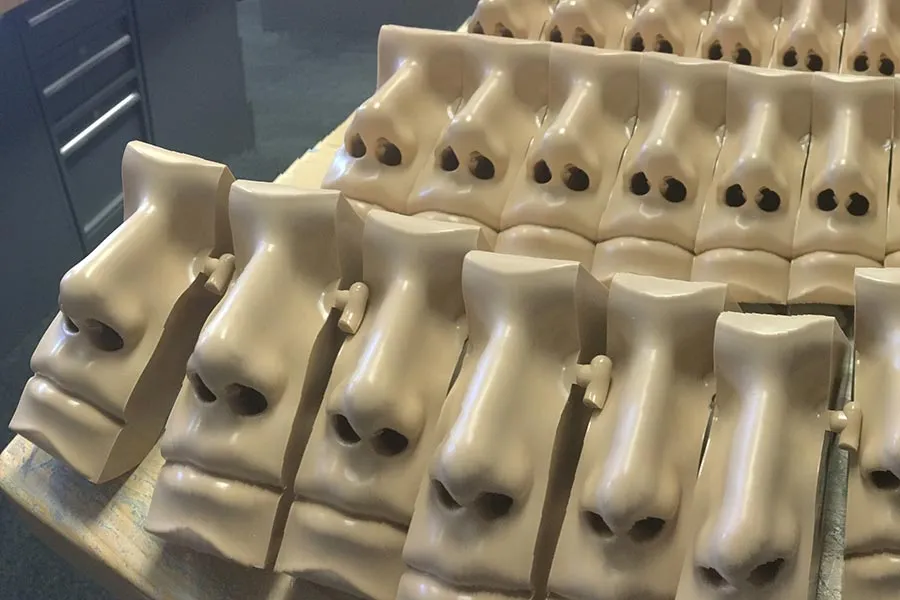
Urethane-Casting Parts
Urethane Casting vs Injection Molding
Compared to injection molding, urethane casting wins over:
- Low tooling cost: Urethane casting uses RTV silicone molds, which are quick to produce and much cheaper than steel or aluminum or steel molds used injection molding.
- Fast turnaround: Molds and parts can be made in days instead of weeks or months like injection molding. The shorter lead time allows faster design iterations and shorter time to market.
- Design flexibility: Urethane casting can easily produce complex shapes, undercuts, and intricate details that might be tough or expensive with injection molding.
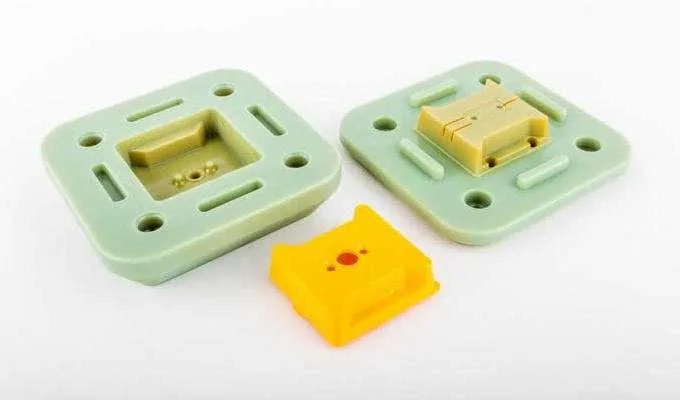
Injection molded sensor housings
However, injection molding wins over:
- Tolerance and consistency: Injection molding can achieve dimensional tolerances as tight as ±0.005 inch, which is roughly twice as precise as those typically attainable with urethane casting.
- Per-part cost for large runs: Silicone molds used in urethane casting wear out quickly, and its manual, labor-intensive process leads to higher per-unit costs as quantity increases. While we have done runs of 5,000 parts, cast urethane tends to perform best with quantities of less than 200 units.
- Material options: Though room-temperature-curing polyurethane resins used in urethane casting are versatile, when compared to injection molding, its range of materials are limited. In addition to that, the materials used in urethane casting are more flexible and tunable, but not as high performance as injection-molded plastics. The reason is that urethane casting uses thermosetting polymers, which cure chemically, not through melting like thermoplastics used in injection molding.
Urethane Casting vs 3D Printing
Compared to 3D printing, urethane casting wins over:
- High-quality parts: Urethane casting delivers smooth surfaces and high-quality finishes with minimal post-processing, and urethane cast parts generally offer greater structural integrity and mechanical properties than most common 3D-printed plastics.
- Cost efficiency for small to medium batch: For batch sizes of 20–200 parts, urethane casting can be faster and less expensive than 3D printing, reducing per-unit costs by spreading tooling expenses over multiple parts
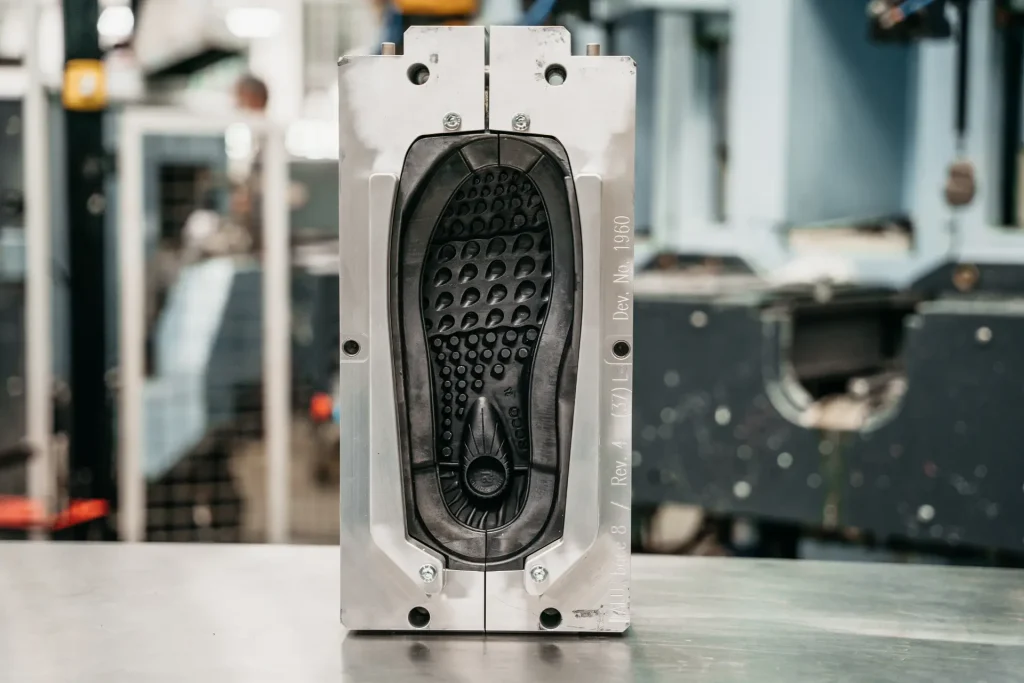
Footwear Mold using 3D Printing
However, 3D printing wins over:
- Lead time: 3D printing can quickly produce parts without the need for molds or tooling, enabling rapid turnaround for single or very low quantity parts. Urethane casting needs several days for mold making, materials prep, casting and curing, and finishing.
- Design flexibility: 3D printing allows for highly complex geometries, internal features, and intricate details that might be difficult or impossible to achieve with urethane casting molds.
When Should You Use Urethane Casting?
Due to its versatility, cost-effectiveness, and fast turnaround, urethane casting are widely used in many industries including automotive, healthcare, medical devices, consumer electronics, and industrial equipment.
At Trimech, here are the typical scenarios we recommend choosing urethane casting over other manufacturing processes:
- Bridge production: When you are planning to move from prototyping to manufacturing through injection molding but aren’t ready for tooling yet. Tooling can be significantly expensive for injection molding, particularly when you need to make design iterations and pay for retooling. Due to the lower tooling costs and faster turnaround offered by urethane casting, and the cast parts having similar finish and mechanical properties to injection-molded parts, urethane casting is ideal when you want to have small batches of production for functional testing and design validation.
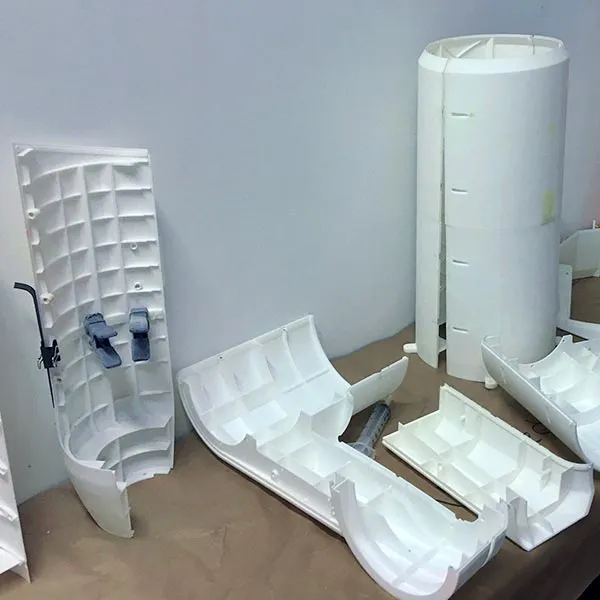
Urethane-cast Parts
- Short-run production: For low to medium volume manufacturing (typically 20-200 parts) of high-quality parts with complex geometries and fine details, urethane casting is often less expensive than injection molding or 3D printing, and it allows replication.
- Solving several key problems at the same time: price point, clear parts, cosmetics (repeatable texture), color matching, repeatability, advanced materials (FR-rated, high impact, high temp, etc.) – Here at TriMech, when we are quoting casting, we want to solve at least 3 problems to help justify urethane casting and refine the manufacturing solution.
What Materials can be Used for Urethane Casting?
Unlike silicone casting that uses silicone rubber to cast into a mold, urethane casting offers a wider range of material options, from rigid to flexible, from transparent to opaque and colored, from heat resistant to chemical resistant, each having different processing time and cost.

Flexible Urethanes
Below are some common materials in urethane casting and their main usage:
- Rubber-like – Shore A 20 – Shore A 90, both natural and UV-stable chemistries.
- Flexible Urethane – Can be pigmented, flexible applications, i.e. gaskets, Bellows, Coverings for pinch points on machinery.
- Rigid Polyurethane: Colored matched, rigid applications, exterior facades.
- FR-Rated Rigid Polyurethane: For parts, and medical houses that require V-0 flammability.
- Rigid Polyurethane – Clear: Can be pigmented, Rigid applications.
| Material | Hardness | Clarity | Mimics | Characteristic |
|---|---|---|---|---|
| Rubber-Like | Shore A 20-90 | Water Clear | Rubber | UV-Stable |
| Rubber-Like | Shore A 20-90 | Amber | Rubber | Durable |
| Flexible Rigid Urethane | Shore D 50-60 | Opaque | PE-like, PP-like | High Impact, Flexible |
| Rigid Urethane | Shore D 70-80 | Opaque | ABS-like | High Impact |
| Rigid Urethane, FR – Rated | Shore D 70-80 | Opaque | UL94-V0 | UL94-V0 |
| Rigid Urethane, High Temp | Shore D 80 | Opaque | PC-like | High Temp |
| Rigid Urethane, Filled | Shore D 80 | Opaque | Glass-filled Nylon | Very Rigid |
Finishing Methods for Urethane Casting
Urethane cast parts are very versatile when it comes to finishing because they can mimic plastics, rubber, or even clear materials.
Below are some common finishing options for urethane cast parts:
- Surface preparation: Before any finishing, ensure your part is clean and smooth by trimming, sanding, or filling.
- Painting: Finished parts can be painted with RAL color-matched paints. Our paints are highly durable and can have a matte or glossy finish.
- Polishing: for rigid and clear parts, use plastic polish or micro-abrasive compounds; for flexible parts, avoid abrasive polishing.
- Coating: Gloss or matte polyurethane sprays can protect painted or raw parts. Some clear urethanes can yellow if exposed to U, so UV-stable topcoats help. To prevent cracking, use flexible coatings on soft urethanes.
- Dyeing: This is less labor-intensive than painting and avoids peeling. Add urethane pigments during mixing. Use liquied or powdered dyes for clear parts.
- Texturing: Sandblasting gives a uniform matte or textured finish. Embossing could be done via mold textures or post-processing.
- Machining: light milling, drilling, or cutting is possible on rigid polyurethane.
FAQs
Can I cast functional mechanical parts with urethane? How durable are urethane cast parts?
Yes, depends on the application. Is the material being used for exterior applications, autoclave buck, or high torque gear? The durability depends on the design and material chosen.
Can I cast over electronics or embed objects in urethane?
Yes, this is called over molding or encapsulation. Over molding adds a soft or rigid coating over a rigid part, like a brush handle with a soft grip. Encapsulation surrounds electronics to protect them from the environment.
Is urethane suitable for wearable or flexible applications?
Urethane is suitable for brief skin contact. Silicone is preferred for prolonged or wearable use due to its inertness.
For Costumes, raised surfaces can be urethane, but silicone offers better flexibility.
How do I replicate an existing part using urethane casting?
Replicate a part by scanning or 3D printing from a CAD file, then a mold is made and injected with the desired material.
How do additives (e.g, colorants, fillers, UV stabilizers) affect the performance of urethane cast parts?
Performance depends on the material and additive. Additives can enhance one property but reduce others; for example, fiber fill increases rigidity and viscosity but reduces flexibility.
Conclusion
Urethane casting is a multi-step process involving master pattern creation, mold making, material mixing, casting, demolding, and finishing. Because of this complexity, it tends to be more labor-intensive and technically demanding than many other manufacturing or prototyping methods, especially when aiming for consistent, high-quality results.
It’s common to run into challenges like:
- Why is my mold tearing or wearing out quickly?
- Why is my cast part sticky or not fully cured?
- Why is the color inconsistent between batches?
- How do I fix warping or shrinkage?
No need to worry. Our experienced team of experts is here to help troubleshoot. Get in touch with us to keep your project moving forward.

Written by Sophie Jin
Sophie (Huiyu) Jin is an SEO/PPC Specialist at TriMech, where she focuses on digital marketing strategies for their additive manufacturing and CAD business units.
Prior to joining TriMech, Sophie worked as a business journalist both in Canada and China, covering various industries, particularly tech companies.
Related TriMech Solution
Learn more about the solutions featured in this Article:
Need a Quote for Advanced Manufacturing?
Contact a TriMech manufacturing expert today and get answers to your questions
Related Content
More advanced manufacturing content from the TriMech team