




Additive manufacturing category at Skills Ontario competition showcases three leading Stratasys technologies and student creativity
 By Karen Majerly, last updated October 21, 2025
Skills competitions, always popular and held around the world, engage youth and prepare them for the highly skilled workforce. “Skills Ontario” has been around for 30 years, helping high school and college students develop skills in skilled trades and technologies.
Since 2023, this Canadian provincial skills challenge has had an additive manufacturing category for post-secondary students, co-sponsored by Javelin (part of the TriMech Group of companies) and Stratasys. This year, 18 students from eight Ontario colleges demonstrated their readiness for employment in the additive field, while being exposed to trailblazing 3D printing systems they wouldn’t usually have access to

Javelins’ Skills Ontario table with the Artec Leo 3D Scanner
Module-based competition included pre-printed components
Tanveer Sayed, professor and Program Coordinator of Mechatronics at Georgian College in Barrie, Ontario, is the Technical Chair for the additive category. Tanveer is a certified Stratasys operator and uses the F370 3D printer as part of Georgian’s mechatronics curriculum. Across Canada, Stratasys systems are sold and supported by Javelin.
Tanveer designed the competition to include several modules – or stations – including 3D scanning, reverse engineering, part fabrication, post-processing, and quality evaluation.
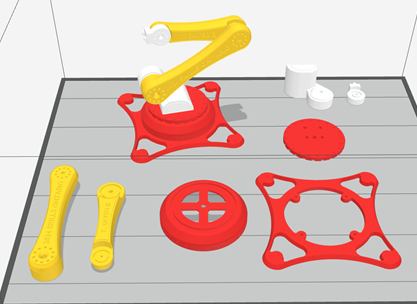
Since 3D printing takes several hours, the criteria allowed for some advance 3D printing, which became a standout feature of the 2024 event. The pre-printed competition model was a robot arm that showcased the capabilities of three Stratasys production systems – the F370 (FDM), H350 (SAF), and Origin One (P3).
“The parts were produced using three different technologies in three different locations, and all 35 models came together flawlessly for the event,” Tanveer said.
Skills Ontario
The right technology for each unique application
Tanveer used Georgian College’s F370 to produce all the arms for the robots. TriMech’s Advanced Manufacturing Services team, already well practiced in collaborating among their various production shops for client projects, printed all the other parts. The Origin One parts were made at the TriMech facility in Rocky Hill, Connecticut and the H350 parts were made by the team in Oakville, Ontario.
Origin One Parts
The Origin One was the production system of choice for the wrist and shoulder components. While known as an economical choice among the Origin One resins, the Dura56 material displays excellent mechanical properties, ensures a smooth surface finish, and results in finely detailed parts. With the wrist being quite small, about 15 of them were easily produced in a single build.
Rich Anino, Additive Manufacturing Solutions Consultant at TriMech, explained how the Origin One masterfully handled the threads within the small parts.
“The wrist included a small M3 thread, and the shoulder had more threads than any other part in the assembly, running in two different directions. We wanted to achieve the best possible accuracy on all the threads, at the print stage, without having to chase up each hole after the fact.”
Origin One Video
This video shows the process of the parts printed on the Origin One and the workflow to get finished parts.
H350 Parts
The remaining robot parts, such as the feet, base, and plate, were a good fit for the H350 3D printing technology, along with the Nylon PA11 material.
“These parts were generally larger, so we took advantage of the H350’s ability to manage larger parts with impressive throughput,” Rich said. “We needed 30 sets of parts, and we could manage 23 per single build. To split the job evenly, we did two print runs of 15 sets each, which took about two days total to print. Given the part size and quantity, the H350 is easily the best technology we have to produce the parts quickly and accurately, in a great all-round durable thermoplastic.”
Rich added that the cost of the Nylon PA11 powder rivals the low cost of the Dura56, so the H350 parts were also significantly lower cost than nearly all other additive technology options for this project.
The wider educational opportunity
In addition to involving students directly in challenges, Skills Ontario seeks to engage a network of industry representatives, educators, academics, and younger students over a three-day period.
Skills Ontario with Colleges and Universities
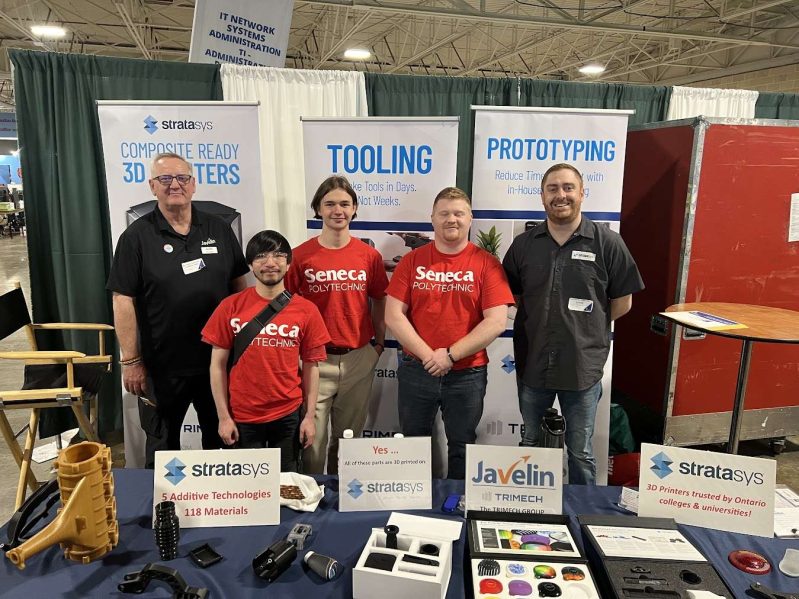
Javelin’s Paul Sesto looks after 3D printer sales in the Ontario educational sector. He said that at least 500 high school and elementary students visited Javelin’s booth with their parents and teachers.
“Even the adults couldn’t believe that our sample parts were 3D printed. And Stratasys had kindly shipped an F370 to the event, so with that system operating alongside us, it was an excellent opportunity to show off what industrial-grade 3D printing looks like. The technology really turns heads.”
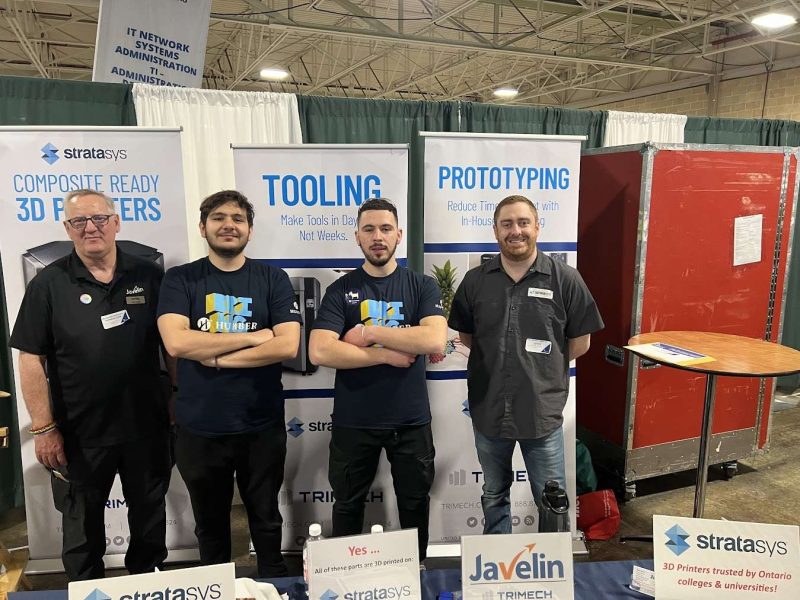
Javelin with Ontario Colleges & Universities
Ongoing commitment from Stratasys
Devon Judge, Education Channel Sales Manager for Stratasys, volunteered as a competition judge for the second time. He emphasized that the ability for students to try, fail, iterate, and find success is an extremely compelling way of learning.
“Stratasys technology immerses beautifully in project-based STEM learning. We see it as our duty to expose educators and the next generation (who continually show us how bright and driven they are, by the way!) to the power of additive manufacturing, which continues to grow across all industries.”
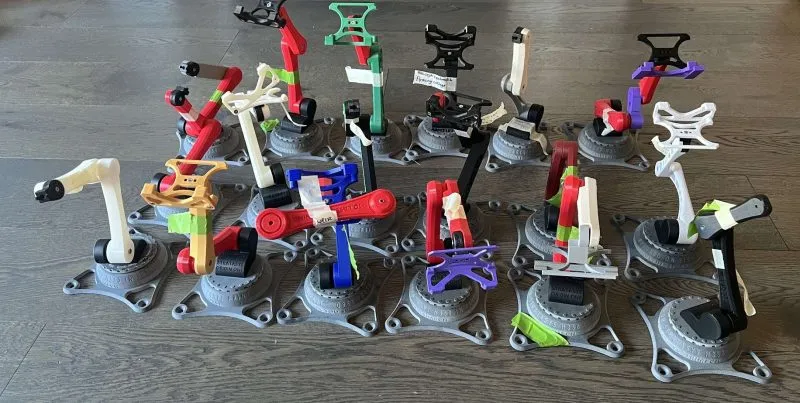
Skills Ontario Prototypes
Design can change the world
Looking ahead to future competition years, Tanveer hopes that other provincial competitions will add a 3D printing category; once three provinces are on board, additive manufacturing can be added to the Canadian national Skills event.
“I tell my students that CAD is their superpower,” he said. “And that maximizing the vast opportunity of 3D printing begins with good design. It’s inspiring for them to understand that our problem-solving skills can lead to better products, a better lifestyle, and a better world.”

Written by Karen Majerly
Karen Majerly is a communications specialist who has been supporting the public relations and marketing activities of the TriMech Group of companies since 2013. With an education in journalism and a stint as a media spokesperson, Karen has a nose for news and loves a great story.
Through countless conversations with TriMech's most outstanding design, engineering, and manufacturing clients, Karen has developed insider knowledge of what manufacturers care about, and how TriMech's people, products, and services help advance their businesses.
Related TriMech Solution
Learn more about the solutions featured in this Article:
Need a Quote for Advanced Manufacturing?
Contact a TriMech manufacturing expert today and get answers to your questions
Related Content
More advanced manufacturing content from the TriMech team