




Aluminum 3D Printing: Pros & Cons, Material Options, and Tech Tips

Aluminum is one of the most common metal materials used in additive manufacturing, especially for high-strength, lightweight parts that require heat and chemical resistance or thermal & electrical conductivity.
In this article, we discuss the benefits, challenges, and applications of aluminum 3D printing, dive deep into the material options, and offer several tech tips for printing with popular aluminum alloys, particularly with the most prominent Laser Powder Bed Fusion (LPBF) / Selective Laser Melting (SLM) technology in metal 3D printing.
Why 3D Print Aluminum?
3D Printing Aluminum vs Machining Aluminum
The benefits of 3D printing aluminum over traditional machining aluminum lie in the fundamental advantages offered by 3D printing:
- Design freedom for complex geometries: 3D printing can create parts with internal channels, hollow or latticed internal features that are hard to achieve with machining.
- Cutting down manufacturing and assembly time: With conventional manufacturing methods, a component may require hundreds of joined parts, while a 3D printed part could be built as a single piece.
- Material efficiency and thus lower material cost: Compared to casting or machining aluminum, 3D printing aluminum wastes significantly less material producing very little scrap for recycling.
Aluminum vs Copper for 3D Printing
Both materials are good at transferring heat, but copper is the King of thermal conductivity. However, it is an expensive material, and aluminum like AlSi10Mg can offer good thermal conductivity at a much lower price.
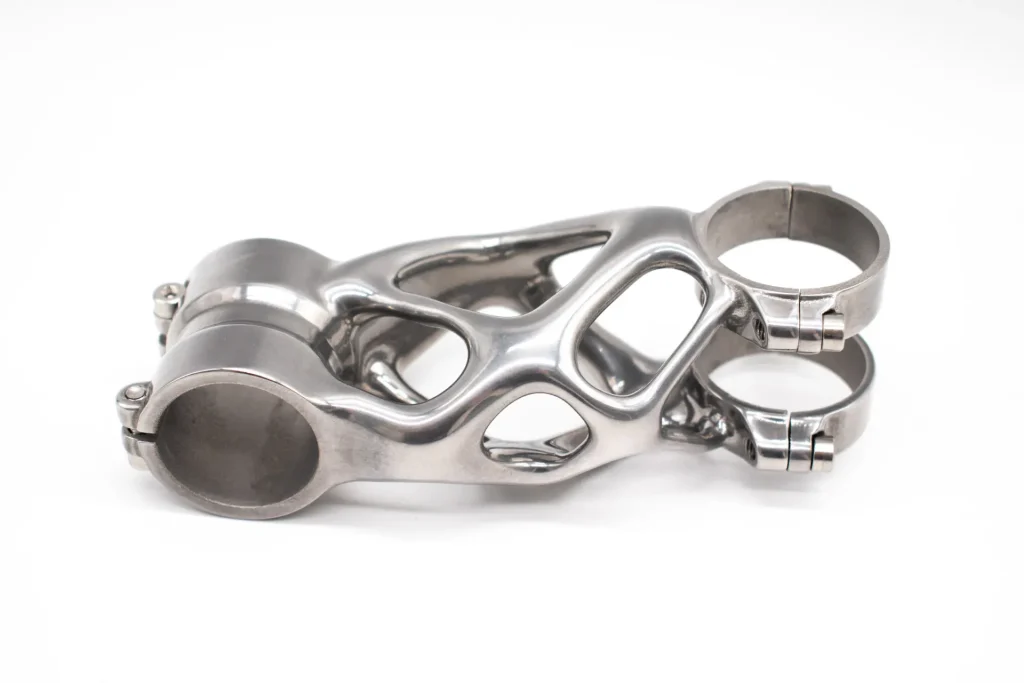
3D-Printed Aluminum Part
Copper is also difficult to print using LPBF/SLM/DMLS, the most common metal 3D printing technology. The reason is that most LPBF printers use an infrared laser, but copper reflects infrared light extremely well (typically 90-95%) – it’s essentially like trying to melt a mirror with a flashlight.
In contrast, aluminum alloys like AlSi10Mg are much easier to print and are significantly cheaper.
Aluminum vs Titanium for 3D Printing
Both materials have an excellent strength-to-weight ratio. While titanium is inherently stronger than aluminum, it is also about two-thirds heavier. As a result, less titanium is needed to achieve the same strength as a larger amount of aluminum. The density of titanium (Ti-6Al-4V) is about 4.4 g/cm³ and cast aluminum (AlSi10Mg) is 2.7 g/cm³.

Titanium alloy part
Titanium is more expensive than most other metals due to a combination of raw material scarcity, complex extraction processes, and difficult processing requirements.
Aluminum is significantly cheaper than many other structural metals due to a combination of abundance, efficient extraction methods and excellent recyclability.
In general, if aluminum is adequate for your application from a strength and weight standpoint, we’d suggest that over titanium, which is more often used in some critical situations where strength and heat consistence are key properties to consider.
Challenges of Aluminum 3D Printing
- Thermal Management Challenges: Aluminum’s high thermal conductivity can cause rapid cooling, leading to warping, cracking, and residual stresses in parts.
- Lower Rigidity: Compared to steel, aluminum parts are less rigid than steel, limiting their use in some high-load applications.
- Limited Alloy Options: Not all aluminum alloys are suitable for 3D printing, restricting material choices for specific needs.
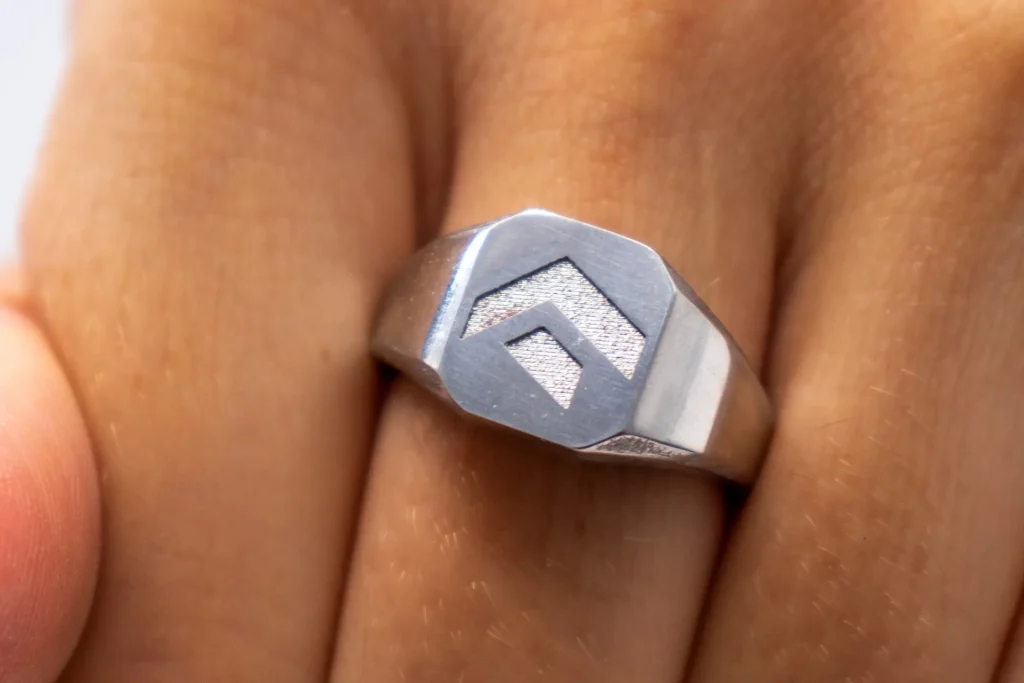
Stainless steel ring
Applications of 3D-printed Aluminum
Due to its excellent strength-to-weight ratio, 3D-printed aluminum is widely used in automotive and aircraft as lighter structures.
Some common applications include:
- Drone and UAV airframes
- Tooling inserts for injection molding & blow molding
- Satellite antenna and RF structures
- Brackets, gearboxes, housings, structural supports
- Bike frames and fishing reels
- Heat sinks and heat exchangers for its thermal conductivity
With emerging printing techniques and novel materials, 3D-printed aluminum is now used in rocket engines, overcoming the challenges of aluminum’s tendency to crack during the 3D printing process and lower melting point (460 – 670 °C) compared to other typical metal used in aerospace.
Aluminum Material Options for 3D Printing
They are almost always aluminum alloys and not pure aluminum.
Aluminum Material Categories
You might find the 4-digit numbering system for certain aluminum materials confusing. What do these numbers mean?
This is an existing category system for the material by the Aluminum Association. This system largely depends on what the aluminum is alloyed with – by looking at the first digit of the number, you’ll know what the primary alloying elements are:
| Series | Principal Alloying Element(s) | Typical Properties & Applications |
|---|---|---|
| 1000 | None (99%+ Aluminum) | High purity, excellent conductivity, corrosion resistance; used in electrical and chemical applications |
| 2000 | Copper | High strength, used in aerospace and military; lower corrosion resistance |
| 3000 | Manganese | Good formability, moderate strength, used in beverage cans and roofing |
| 4000 | Silicon | Lower melting point, used in welding and brazing |
| 5000 | Magnesium | High strength, good corrosion resistance, used in marine and transportation |
| 6000 | Magnesium & Silicon | Good strength and workability, used in structural applications and extrusions |
| 7000 | Zinc | Very high strength, used in aerospace and high-stress applications |
| 8000 | Other Elements | Specialized alloys for unique applications (e.g., lithium, iron) |
For example, the 6000 series and 7000 series are primary Aluminum-Magnesium-Silicone, and Aluminum-Zincs respectively.
The 1000 series are considered ‘pure aluminum’ and are hardly chosen because they lack strength and have poor mechanical performance – in fact, most useful aluminums are almost always alloys and not pure aluminum, especially in the 3D printing industry.
Beyond that, the remaining 3 digits are used as a specific identifier for specific alloys within that category:
- The second digit indicates modification to the original alloy. A “0” means it is the original alloy; other numbers indicate a variation or modification of the original alloy.
- The last two digits identify the specific alloy without indicating any particular property.
Popular Aluminum Alloy for 3D Printing
Not all aluminum alloys are suitable for the rapid melting and rapid solidification in metal 3D printing processes. The 2000 and 7000 series work well with 3D printing, as does cast aluminum (AlSi10Mg). Cast aluminum is a subset of aluminum alloys (including both cast and wrought alloy) that often have higher silicon content and falls outside the traditional four-digit numbering system.
AlSi10Mg: the go-to aluminum alloy in LPBF
This common, easy-to-print material designed for casting is relatively strong but also brittle – not much flexibility in your printed parts without a heat treatment. As is usually done, you can do a T5 or T6 heat treatment to improve ductility. But the printing process with LPBF is inherently easy.
Choose AlSi10Mg when:
- Strength (ability to resist static load) is more important than cyclic toughness (the ability to resist dynamic/repeated load)
- Cost is a driving factor
- You are trying to make something with fragile geometry like lattices, thin walls, or intricate channels
- You are making heat exchangers and trying to save money by not printing copper.
A6061-RAM2: most popular among 6000 series for aerospace
The 6000 series traditionally don’t work well with 3D printing, as they’re likely to suffer from hot cracking and have poor weldability.
However, A6061-RAM2, the specially formulated aluminum alloy for LPBF and DED process, has had great improvement in its printability. It’s based on 6061 aluminum alloy but incorporates proprietary ceramic additives using Elementum 3D’s Reactive Additive Manufacturing (RAM) technology. This material has been used in 3D printed-rocket engine nozzle that offers great savings on weight for high structural loads and enough heat resistance for use on rocket engines.
A6061-RAM2 is not qualified on many LPBF systems, but it is supported on select platforms, including One Click Metal’s BOLDSERIES. This aluminum alloy can be used immediately upon machine setup, with pre-established print parameters – eliminating the need for manual process development.

OCM – BOLDSERIES – MPRINT
As a broader material category, A6061 is the best fit for lightweight part to help add structural integrity to a system or assembly. It is usually valued for its strength-to-weight ratio, good corrosion resistance, and strong fatigue resistance, which means that it handles cyclic loading very well – aerospace and automotive industries often utilize it in key systems for this reason. It’s about 2-3x more ductile than AlSi10Mg. Even with heat treatment, AlSi10Mg still could not compare with 6061 regarding fatigue resistance and ductility so it’s recommended to use 6061-RAM2 for critical applications.
A7075: for fatigue critical applications
The 7000 series are Aluminum-Zinc alloys engineered for maximum strength, often used on high-performance airframes, racing structures, missiles, etc.
The most common of these is A7075. It has high strength, low ductility, and is used for the most important performance parts – usually cyclic loaded, fatigue critical applications. A7075 was a nightmare to weld or 3D print but is now printable by some LPBF systems thanks to Elementum3D’s RAM technology.
Tech Tips for Printing with Aluminum Alloy
Selective Laser Melting (SLM), or Laser Powder Bed Fusion (LPBF), is the most common metal 3D printing technology to print with aluminum. It builds aluminum parts by spreading powder in thin layers and using a laser to selectively fuse each layer, repeating this process until the part is complete.
Compared to other 3D printing technologies such as Electron Beam Melting (EBM), Metal Binder Jetting, Wire Arc Additive Manufacturing (WAAM), or even FDM, SLM/LPBF produces the strongest aluminum parts and is ideal for high-performance applications. For critical applications requiring maximum strength and precision, it remains the gold standard.

One Click Metal Clamps
In general, aluminum is not such a challenging material to print with. But because of its great capability of absorbing and transferring heat, it can cause heat from the laser to spread quickly away from the melt pool. Some potential risks include:
- If the melt pool cools too rapidly, it can lead to incomplete melting or bonding between layers.
- The inconsistent melt pool can also result in tiny voids from inside the printed part, which will reduce its mechanical performance.
- The temperature differences within the printed part could also create internal stress and cause warping and cracking.
We’d suggest preheating the build plate upwards of 200°C to prevent the heat from escaping too quickly.
How to Print with AlSi10Mg?
In the most normal cases, choose AlSi10Mg as the go-to LPBF material as there isn’t anything inherently difficult about printing the most common AlSi10Mg with LPBF technology.
- AlSi10Mg has good weldability and forms a stable melt pool during the LPBF process, which reduces the risk of defects like cracking or poor layer adhesion. This makes the printing process more robust and less sensitive to minor variations in process parameters
- In most LPBF systems, overhangs below 45° from the horizontal usually require supports because the powder bed cannot adequately support the molten metal, leading to poor surface quality or collapse. However, AlSi10Mg’s favorable melting and solidification behavior allows for successful printing of overhangs at much lower angles (as low as 20°), expanding design freedom.
- Plus, this light metal makes unsupported overhang less likely to sag or deform under their own weight during the build process compared to heavier metals!
Due to these strengths, engineers can design more complex geometries with shallow overhangs and fewer supports, reducing post-processing work and material waste. And the ability to print low-angle overhangs directly leads to faster builds and lower costs, as less time is spent removing supports and finishing parts.
Heat treatment for AlSi10Mg
However, as mentioned above, heat treatment is required to adjust mechanical properties. There are two ways of doing it:
- T5 heat treatment: This method maintains most of the as-printed strength while moderately improving ductility. It’s safe to use and does not drastically change the microstructure. It can be used when you need a balance of strength and fatigue resistance (e.g., structural components).
- T6 heat treatment: The microstructural change during this process leads to a significant increase in elongation (ductility), but ultimate tensile strength typical drops due to the coarsened silicon, and the fatigue resistance remains inferior to T5. Use T6 only if ductility is prioritized over fatigue performance (e.g., parts requiring plastic deformation tolerance).
How to Print with A6061?
Design the supports in a right way: With the right design of support structure, you can sometimes tear supports off your part rather than machining them after printing. Optimize your design as first step to balance easy removal with adequate part stability during printing.
Print with a lower layer height: Thinner layers generally improve surface finish, making aluminum parts smoother and reduce the need for post-processing.
But that improvement is limited, and you still need post-processing for finish: bead blasting to get a better surface finish, some polishing if desired, powder coating if desired, etc.
Use HIP treatment and T6 heat treatment to improve mechanical properties as much as possible and reduce internal porosity for performance-level parts.
Conclusion
The unique combination of aluminum’s lightweight, strength, and thermal properties makes it an ideal candidate for high-performance, complex applications in aerospace, automotive, and electronics. LPBF/SLM remains the gold standard for producing strong and precise aluminum parts, with ongoing material innovations expanding the range of applications of aluminum 3D printing.
While challenges remain (such as thermal management, limited printable alloys, and the need for careful post-processing), aluminum 3D printing is evolving with new techniques and materials to make it more accessible and reliable.
If you have more questions on printing with aluminum alloy, please contact our 3D printing services team.

Written by Sophie Jin
Sophie (Huiyu) Jin is an SEO/PPC Specialist at TriMech, where she focuses on digital marketing strategies for their additive manufacturing and CAD business units.
Prior to joining TriMech, Sophie worked as a business journalist both in Canada and China, covering various industries, particularly tech companies.
Related TriMech Solution
Learn more about the solutions featured in this Article:
Need a Quote for Advanced Manufacturing?
Contact a TriMech manufacturing expert today and get answers to your questions
Related Content
More advanced manufacturing content from the TriMech team