





A Comprehensive Study of DyeMansion VaporFuse Surfacing on FDM Parts

This white paper will go into detail about the effects of DyeMansion VaporFuse Surfacing (VFS) on Aerospace FDM parts built in ULTEM 9085. It covers what VaporFuse Surfacing is and how the mechanical properties were altered from surface finish roughness, tensile strength, elongation, flammability.
DyeMansion VaporFuse Surfacing Impact on Advancing Additive Manufacturing
As the adoption of Additive Manufacturing increases, it is imperative to improve the strength and durability of parts.
FDM is one of the most widely adopted 3D printing technologies. The Stratasys line-up of materials includes many high-performance filaments. Tools and Processes like VFS enhance material properties, furthering the capabilities of FDM 3D printed parts.

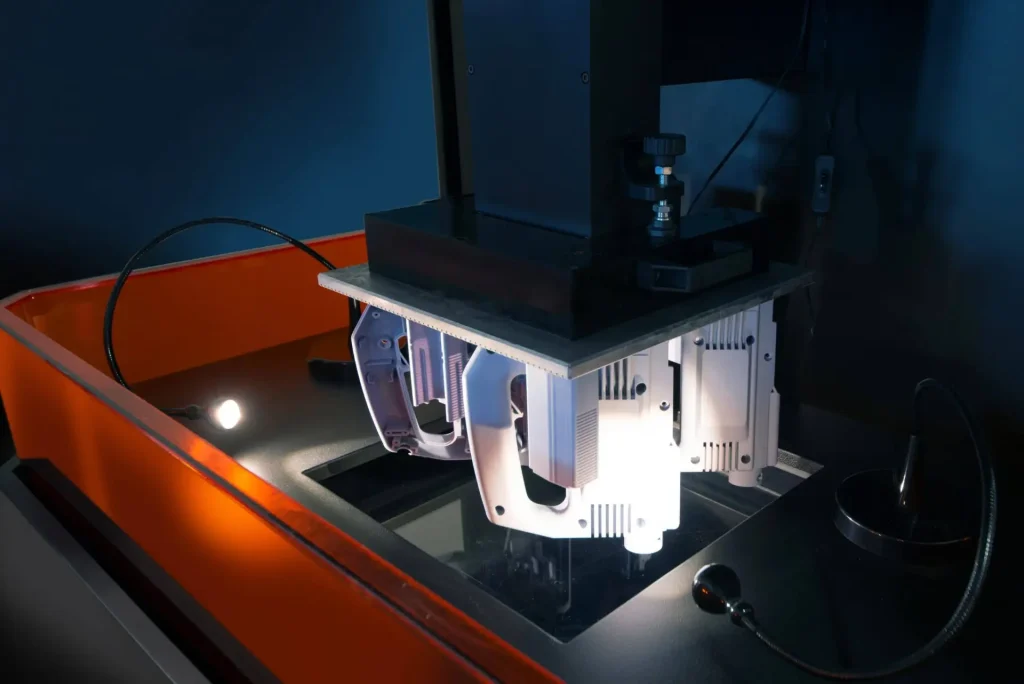
DyeMansion VaporFuse Surfacing ULTEM parts
Getting More from Materials
This study demonstrated the significant impact that VVFS can have on enhancing the esthetics and performance of additively manufactured parts, specifically those made from ULTEM 9085 resin.
As a leading additive manufacturing provider, Stratasys pushes the boundaries of what is possible, striving to glean valuable insights that not only advance aerospace manufacturing but also hold potential applications across various other industries. Through rigorous testing and analysis, we have demonstrated the transformative power of DyeMansion’s VFS on 3D-printed parts made from ULTEM 9085.
The significant improvements in mechanical properties, flammability, dimensional stability, part visuals, and surface roughness achieved through VFS exemplify our dedication to optimizing AM solutions for aerospace applications.
Need a Quote for Advanced Manufacturing?
Contact a TriMech manufacturing expert today and get answers to your questions
Related Content
More 3D printing and manufacturing content from the TriMech team
3D Printing Post Processing Survey Trends Report 2026
3D Printing Post-processing is where additive manufacturing either delivers or falls short. This year's trends report from PostProcess® Technologies shows exactly where the industry stands and where it's heading.

What is Cold Metal Fusion and How Does it Work?
Cold Metal Fusion is a sinter‑based 3D printing process that uses polymer‑bound metal powders to create high‑quality metal parts through SLS, debinding, and sintering

How Subaru used 3D printing to cut tooling development time by 50%
Learn how Subaru of America’s Accessories Product Development team replaced expensive, outsourced tooling with in-house 3D printing, utilizing the Stratasys F770 to reduce costs by 70% and cut tooling development time by over 50%.