





Automated FDM Support Removal: Optimizing Post-Printing Workflows at J.W. Speaker
Learn how J.W. Speaker has adopted automated FDM 3D printing support removal using the Postprocess BASE machine, allowing them to cut manual labor, boost throughput, and deliver clean, production-ready fixtures faster.
Solutions featured in this Case Study
 3D Printers
 3D Printing Materials
 Digital Manufacturing Solutions
 Finish Your Products
 Make Your Products
 Manufacturing Services
J.W. Speaker designs and manufactures cutting-edge, high-performance LED lighting technology for automotive, powersports, transportation, and industrial applications. With a strong focus on innovation and quality, their products are designed, manufactured, and assembled in Germantown, Wisconsin.
A longtime adopter of additive manufacturing (AM), J.W. Speaker has been using 3D printing in their facility for over a decade. With the goal of using FDM printing to replace traditionally machined assembly fixtures, they purchased a Stratasys F3300 FDM printer. To fully capitalize on the F3300’s potential, they needed an automated support removal solution to improve throughput and streamline labor-intensive processes.
J.W. Speaker integrated the PostProcess® BASE™ FDM support removal solution into their facility. Dramatically accelerating turnaround times, reducing manual labor, and boosting overall production efficiency.
The Challenge: Manual Bottlenecks Slowed AM Efficiency
J.W. Speaker 3D prints between 10 and 50 parts per week, primarily serving the automotive and motorsports industries with LED lighting technology for functional fixtures and gauges. Their equipment includes Stratasys F370CR, Origin One, and HP MJF printers—with FDM as their dominant technology.
Prior to adding automation, J.W. Speaker relied on a manual post-printing process that was both time-consuming and labor-intensive.
- Labor Intensive: Removing FDM support material required extensive operator involvement, including manually clearing threaded holes and intricate geometries.
- Lengthy Process: The workflow involved soaking parts in sodium hydroxide, rinsing them thoroughly, and drying them overnight in an oven.
- Scalability Issues: This multi-step workflow created bottlenecks, delayed part availability, and limited the ability to scale production efficiently.
The manual cleaning station also created challenges for larger fixtures, often requiring engineers to piece together parts due to drying constraints and long processing times. As print volumes grew, this existing process could no longer keep up with demand.
The Solution: Automated FDM Support Removal
To overcome these bottlenecks, J.W. Speaker partnered with PostProcess Technologies to implement the BASE FDM Support Removal Solution—an automated, spray-based system designed for high-throughput post-printing. Simultaneously, they introduced the Stratasys F3300™, a next-generation FDM printer that delivers faster print speeds and larger part capacity. These two technologies were acquired to work together, creating a more efficient and scalable additive manufacturing workflow.
- Replacing Traditional Tooling: The F3300 allowed the team to shift tooling applications, such as pallets and fixtures, from traditional machining to 3D printing. This transition reduced labor, increased turnaround times, and aligned well with the PostProcess BASE solution
- Automated Finishing: The PostProcess BASE solution eliminated prolonged soaking and drying, automating the entire post-printing process to deliver consistent, high-quality results with minimal operator involvement.
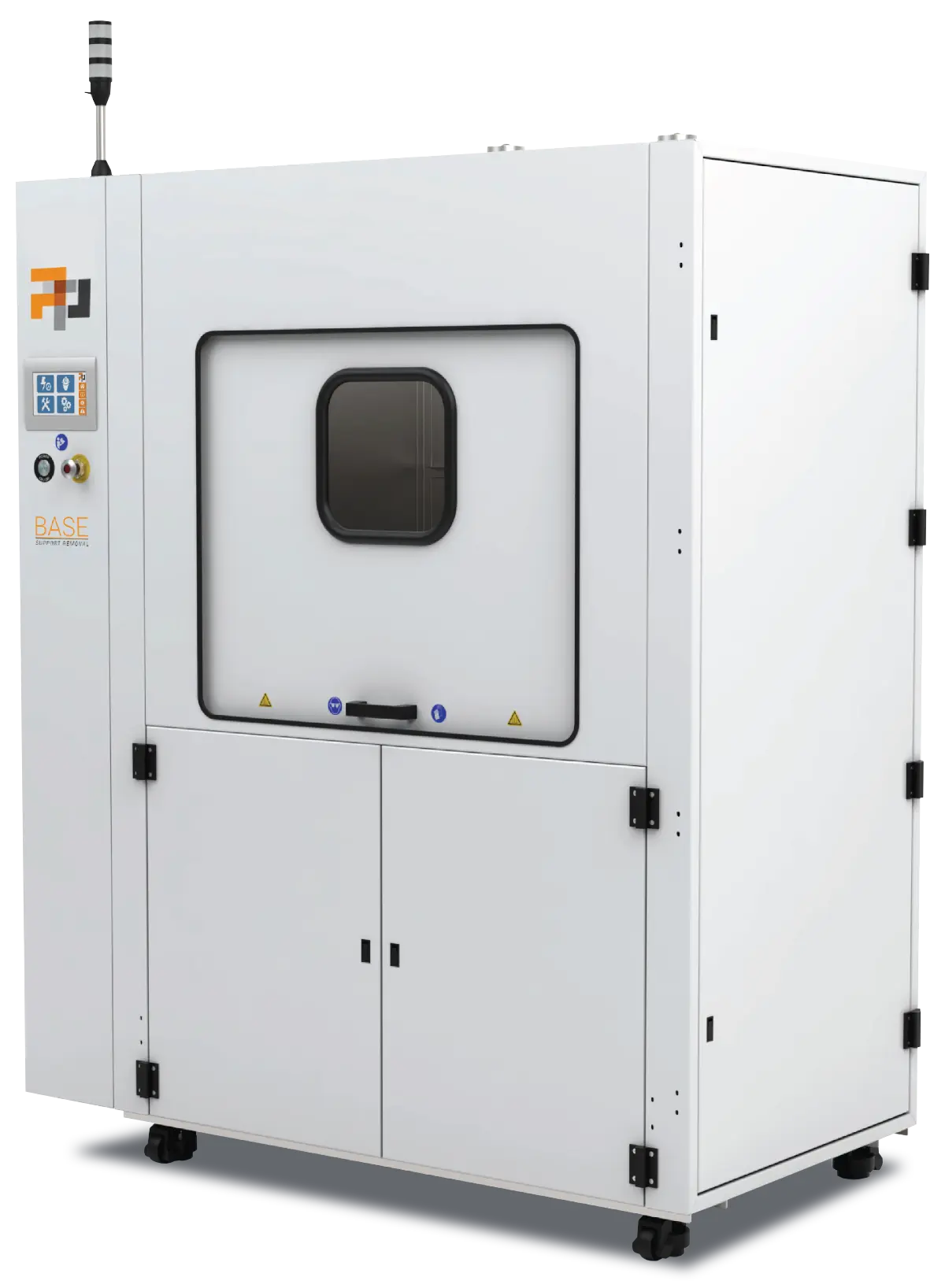
PostProcess BASE
The Results: Faster Turnaround, Reduced Labor, And Scalable Growth
Since adopting these solutions, J.W. Speaker has achieved measurable improvements in productivity, cost-efficiency, and workflow scalability.
1. Drastic Time Savings
Parts that previously required overnight drying after prolonged soak times can now be dried and ready in as little as 10 minutes. This improvement has eliminated multi-step printing delays, giving engineers and technicians faster access to finished parts, allowing production to keep up to pace with tight deadlines.
By replacing machining with 3D printing and automating post-processing, J.W. Speaker realized a 78% time savings (from 1 week to 9 hours) Compared to outsourcing, that figure jumps to 89%, cutting turnaround from two weeks to just 9 hours.
“With our old machine, we would have to put the parts in an oven overnight to dry out. Now, we have the parts cleaned and ready to be delivered in just a couple of hours.”
— Michael Speaker, Lead Additive Manufacturing Specialist
2. Substantial Cost Reductions
By pairing the BASE FDM Support Removal Solution with the Stratasys F3300, the team has shifted a significant portion of their pallet and photometry fixture production from traditional machining to additive automation, saving an estimated $60K–$75K annually. These savings stem from reduced outsourcing, reduced labor, decreased material waste, and improved part consolidation.
3. Improved Design Freedom
The team can now handle larger fixtures (up to 18” x 18”) in a single build, reducing the need for segmented parts and post-print assembly. This has simplified the fixture design process and improved the structural integrity of their builds.
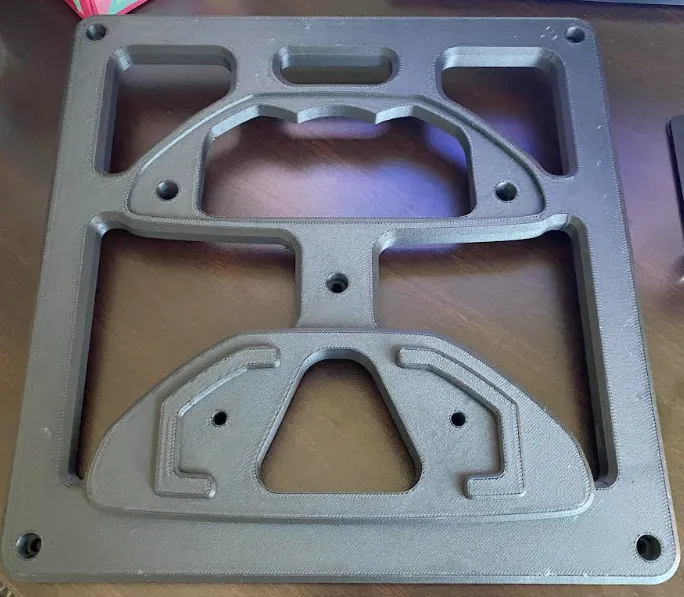
3D printed pallet used in J.W. Speaker’s lighting production
Conclusion
With faster processing, more consistent results, and reduced reliance on manual labor, technicians now have more bandwidth to focus on design innovation and process optimization.
This transformation has paved the way for continued expansion. Over the past five years, J.W. Speaker has grown from just two to six additive machines, and their investment in post-processing automation has been key to sustaining that growth. By removing bottlenecks and scaling throughput, they’ve built a more resilient and future-ready additive manufacturing operation – one that’s equipped to meet evolving demand with speed, precision, and confidence.
Ready to implement an automated workflow for your parts? Contact us today. To learn more about the BASE, check out our Post Processing Service to finish your parts. Whether you are in need of a finishing solution for a single project or just looking into automated processes. Our Custom Part finishing services can help give you access to industry leading technology.
Related TriMech Solution
Learn more about the solutions featured in this Case Study:
More Case Studies and News Stories

How Subaru used 3D printing to cut tooling development time by 50%
Learn how Subaru of America’s Accessories Product Development team replaced expensive, outsourced tooling with in-house 3D printing, utilizing the Stratasys F770 to reduce costs by...
Advancing Food Safety Standards with Cutting-Edge Filtration Solutions
Learn how AMT’s PostPro Chemical Vapor Smoothing technology was used to help make 3D printed parts meet rigorous food safety standards by sealing and removing...
GO Orthotics prioritizes customers by switching to 3D printing
In orthotics, innovation meets efficiency with GO Orthotics diving into 3D printing. Founder Tim Ganley reveals how teaming up with Stratasys and their H350™ SAF™…