




 By
By Whether you are looking to replicate or modify physical items for product development, replace and restore broken parts, or verify the accuracy of a printed object against its digital model, 3D scanning has become an indispensable tool in today’s workflows. By capturing intricate details and complex geometries quickly and efficiently, 3D scanners extend the functionality of 3D printers. In this article, we gathered various use cases to understand the specific applications where you might need a 3D scanner and 3D printers together to maximize your capabilities.
Key Takeaways:
Three applications of 3D scanners for 3D printers:
- Reverse Engineering: Capture the geometry of existing parts to recreate components for machinery without available data.
- Replication: Create precise models of damaged or worn parts for restoration or replacement, useful in art and mechanical repair.
- Quality Assurance: Compare printed objects to their original designs for quick detection of deviations or defects, ensuring accuracy and consistency.
Applications using 3D Scanners and 3D Printers
3D Scanners in Reverse Engineering
When you lack access to drawings or model data of critical parts, reverse engineering becomes essential for uncovering the design of an object. This process is crucial for a wide range of applications such as designing jigs or fixtures, and aftermarket parts. A 3D scanner accelerates this by creating digital models of existing objects, which can then be edited and 3D printed.
Reverse engineering is the most common application for a 3D scanner and 3D printer across industries such as manufacturing, automotive, and aerospace.
Manufacturers often need to build onto things they don’t control or no longer have data for, or to recreate components for old machinery. By scanning an object, they capture its geometry digitally and reproduce the part with 3D printing.
Case Study: Weldco-Beales Manufacturing
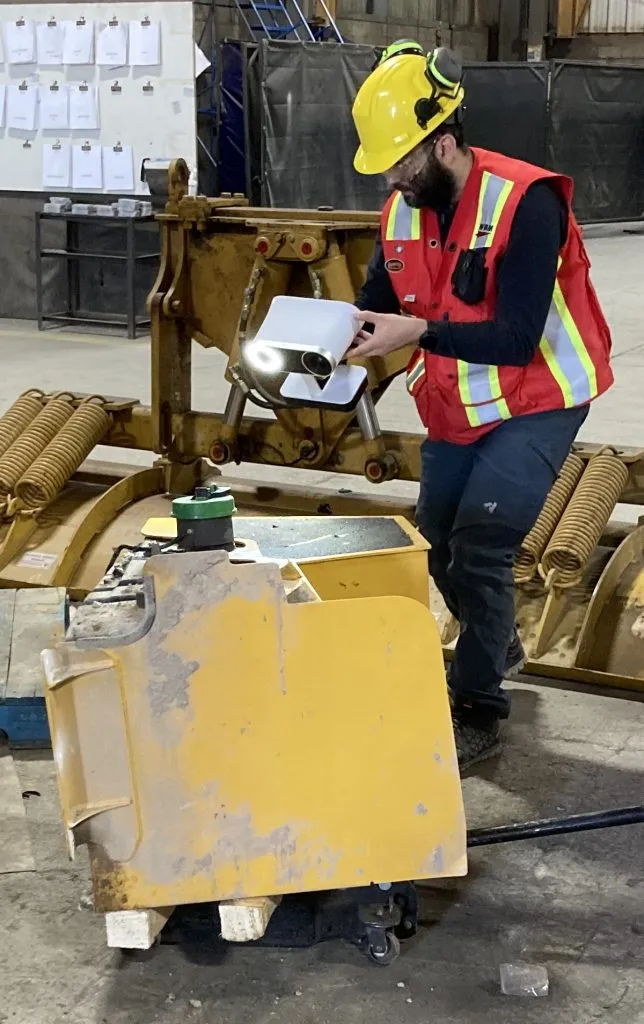
WBM designer scanning a component of the backhoe
Weldco-Beales Manufacturing(WBM) specializes in designing and manufacturing heavy equipment attachments. Machines often exposed to harsh conditions may become damaged or modified so they no longer match the original CAD data. That means although CAD models may exist, they may not reflect the current state of the equipment as accurately as scanned data.
To precisely capture the geometry of the original machine they will build onto, WBM uses the Artec Leo, known for its high accuracy and portability. This scanner performs exceptionally well in challenging environments, including outdoors, on uneven ground, at height. For WBM, investing in the Artec Leo has proven to offer significant value and a quick return on investment.
Case Study: Z1 Motorsports
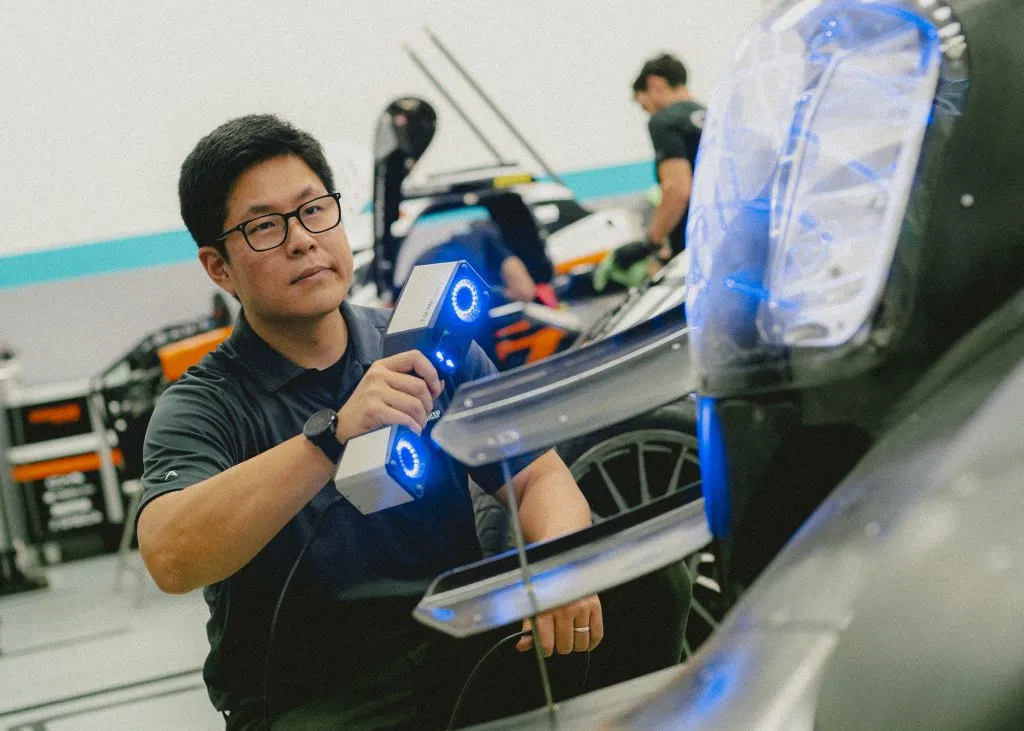
Z1 Motorsports provides parts and services for Nissan Z sportscars. Since they don’t receive CAD data directly from Nissan-Infiniti, they perused 3D scanning as the first step in product development.
Z1 uses a combination of Artec 3D scanners for various tasks:
To capture more details, they use the Artec Space Spider, which can “scan the dust in the air”. This 3D scanner has a 3D point accuracy of 0.05mm and a 3D resolution of 0.1mm, well suited to scan objects with sizes from a pencil to a basketball.
To scan an entire car in a more efficient way, they use the wireless Artec Leo. In a couple of minutes, they get to see the entire 3D replica built in real time on Leo’s touch screen.
With an industrial 3D printer such as the Stratasys F370CR, they could 3D print its parts and go to market more swiftly. The F370CR printer is a good fit for automotive jigs and fixtures, as well as engineering aftermarket parts due to its ability to print in carbon fiber-filled materials. Other automotive aftermarket companies use the H350 to produce mid-volume end-use parts.
3D Scanners for Replication
In fields like art restoration or mechanical repair, 3D scanners help by creating precise models of damaged or worn-out parts. These models can be used to produce replacement parts or to restore objects to their original state. This is particularly useful for preserving historical artifacts or repairing machinery.
Case Study: Tuskegee Airmen
TriMech has created and donated four lifelike bronze busts of the Tuskegee Airmen, a group of African American World War II fighter pilots, to the New England Air Museum, to acknowledge and celebrate the sacrifices and dedication of these men.
We sent our technician to scan the four Tuskegee Airmen, each taking around one minute to capture with the wireless Artec Leo. The Leo does not need registration dots as visual markers to aid the scanning, and its resolution of 0.1mm is ideal for capturing details of the Tuskegee Airmen.
After scanning, we printed the four busts, one at a time on the Stratasys Neo 450, with each bust taking 64 hours to print. With its Stereolithography (SLA) 3D printing technique, Neo 450 offers great resolution and surface finish.
We also considered using our FDM printers which are ideal for large parts with durable materials, but the slight layer lines would need to be filled and sanded. Our PolyJet printers were also an option for us, as the Leo captured full-color data. But the longevity of PolyJet for a museum display was of concern.
Case Study: Camosun Innovates

14-foot mandible (jawbone) replica of a bowhead whale
To get precise and durable replica whale bones cost-effectively, the team at Camosun Innovates uses the combination of the Artec Eva and the Stratasys F900 FDM printer for museum exhibits, saving many thousands of dollars and shaving nine months off the production line.
The Stratasys F900 tray measures 36 x 24 x 36 inches and has 18 cubic feet of build volume, which is well suited to print large-scale projects like these (one jawbone replica is 14 feet long).
>>> If you are interested in 3D printing as well, don’t miss our 3D Printer Buying Guide. <<<
Case Study: The 1955 Sequoia Falco
In his re-creation of the 1955 Sequoia Falco, aviation expert Michael Shuler used the handheld Artec Eva to measure the landing gear doors which are located on the belly of the plane and hard to access. The versatile Artec Eva helped Shuler get the scanned data within an hour and the ultimate processed model within one day.
3D scanners have found applications of replication in some unusual situations as well. For instance, when replicating intricate metalworks of historical significance, people had to work on old, tall buildings, bolt wooden frames to the structures, and pour silicon molds. But with a handheld Artec 3D scanner, they can easily email the files to themselves, leading to significant savings that are hard to even quantify.
3D scanners for quality assurance
Beyond reverse engineering and replication, another common application for 3D scanners is metrology, when 3D scanning is used to compare a printed/machined object against its original design intent to ensure accuracy and consistency. This process helps in quality control by detecting deviations or defects in the printed part in several minutes, even when the parts are still hot right off the machine.
Case Study: Z1 Motorsports
In addition to reverse engineering, Z1 Motorsports uses 3D scanners for inspection. Their automotive parts can be very complex and have somewhat organic shapes. They may define a profile tolerance for the part that’s impossible to measure with a set of calipers. Instead, they scan the part with the Artec scanners and overlay that scan with their CAD model, and the software will tell them how close that part is to the nominal shape.

ATOS Q scanning part
But if someone has a problem that demands the absolute gold standard of accuracy, resolution, and speed, then the GOM ATOS Q is the best choice. It automates not only the measurement with a turntable, but also the reporting by integrating GOM Inspect Professional software. With a 3D resolution of less than 0.03mm and 3D accuracy of ±0.005mm, the ATOS Q is also well suited for sheet metal parts that have complex geometries.

GOM Scan 1 in use
If a company is mass producing a small set of parts with a printer like the Stratasys H350, then the ATOS Q and GOM Scan 1 are great because they are easy to set up quickly and it only takes a minute or less to scan a part on an automated turntable. The GOM Scan 1 features the same core technology as the ATOS Q at a lower price, being a perfect “Little Brother” system for organizations looking to get started in 3D scanning for inspection.
Conclusion
Integrating a 3D scanner and 3D printer can significantly enhance efficiency and open up new possibilities for your projects. Whether you’re focusing on reverse engineering, replication, or quality assurance, the right combination of tools can transform your workflow. Contact us for expert advice on selecting the best products and optimizing your processes.

Written by Sophie Jin
Sophie (Huiyu) Jin is an SEO/PPC Specialist at TriMech, where she focuses on digital marketing strategies for their additive manufacturing and CAD business units.
Prior to joining TriMech, Sophie worked as a business journalist both in Canada and China, covering various industries, particularly tech companies.
Related TriMech Solution
Learn more about the solutions featured in this Article:
Need a Quote for Advanced Manufacturing?
Contact a TriMech manufacturing expert today and get answers to your questions
Related Content
More advanced manufacturing content from the TriMech team