




Build Supply Chain Resilience: How TriMech Can Help to Mitigate Tariff Impacts

In the latest Q1 2025 Manufacturers’ Outlook Survey conducted by National Association of Manufacturers(NAM) in February this year, trade uncertainties and increased raw material costs surged as the top 2 challenges for manufacturers.
We have begun to see cost increases, inventory stockpiling, production slowdown, delayed delivery and purchasing of capital equipment for manufacturers who source parts or materials from affected countries.
To navigate an unpredictable trade landscape, strengthening supply chain resilience has become a top priority for participants in the manufacturing industry.
How TriMech can help? We can help you get more flexibility and power in your supply chain, from initial design to production.
How We Help Increase Material Efficiency
As foundational materials in manufacturing, steel and aluminum pose an immediate cost increase.
You might instinctively try to find alternative materials that avoid the tariff surcharge, but with that choice you may be subject to trade-offs of cost and performance, making them unviable or less desirable options.
Instead of solely considering replacing existing materials you can focus on increasing material efficiency, which can be realized by re-engineering parts using some powerful tools such as topology optimization and the Sustainability Tool in SOLIDWORKS.
Topology optimization is a method used to optimize your material layout and maximize performance within a given design space, conditions and constraints. It’s widely used in mechanical and structural design to reduce weight and material costs while maintaining functionality. It is well suited for applications where parts undergo a mechanical force, as you can build the parts with less material, faster turnaround time, and sustain the same mechanical forces.
Imagine a company that produces drone components using aluminum imported from a country now subject to tariffs. By applying topology optimization:
- They reduce aluminum usage.
- They redesign parts for local 3D printing using aluminum or even polymer composites.
- They shift final assembly closer to the customer base, sidestepping import tariffs.
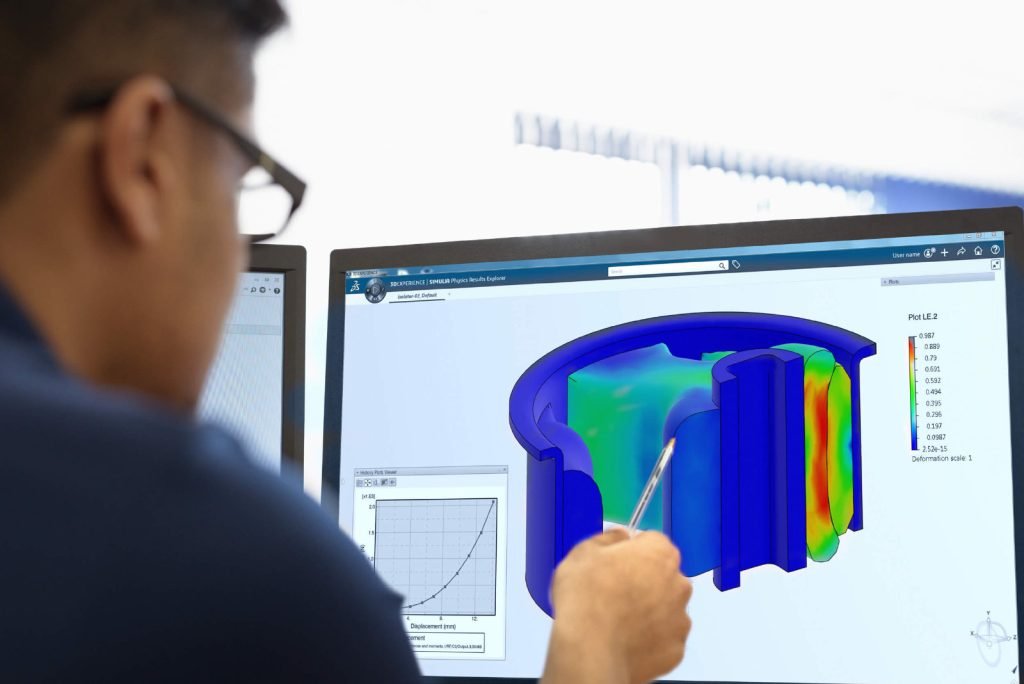
Design simulation and analysis
This way, companies can lower exposure to tariffed metals without needing a direct substitute. But topology optimization is more than that – it can also be adapted to design for alternative materials that may not be tariffed or are locally available. This not only lowers costs but also enhances flexibility and reduces dependence on any single material. Ultimately, it enhances supply chain resilience by diversifying material sourcing.
There are some other tools for improving material efficiency such as the Sustainability Tool in SOLIDWORKS, which allows you to look at alternate materials with similar material characteristics, the carbon footprint and transportation cost for the designs.
TriMech has decades of experience in optimizing the whole manufacturing process from design to production, which includes increasing material efficiency.
For the initial stage of design, we provide the following solutions to help you get your design right the first time or improve upon your current parts:
Simulation Solutions
Both SOLIDWORKS Simulation Professional and Premium has the Topology feature within that allows you to optimize the material layout of a part. We also have TruForm SW as a built-in tool that is part of the Professional/Premium software. Our dedicated, experienced engineers will support you from onboarding to delivering success.
Hands-on Practical Training
We have thousands of courses including simulation training to perform your job better. We offer live online instruction instead of recorded videos from certified trainers to provide best practices and tips, and live access to the instructor.
Product Design Services
To help you stay agile and adaptive, we take on design work including CAD design to make your project more efficient. Our Design for Manufacturing team can cater to small or large corporations with design and manufacturing experts with experience at industry leaders like Apple, Nike, and Dell.
Find the Right People
We could help you find the right people whether as temporary placement as contract, contract-to-hire, or direct hire. Our Staffing team has built contacts and connections over decades with dedicated account management and support.
How We Help with Strategic Reshoring
Shifting supply base or manufacturing processes to tariff-exempt countries can eliminate costs for previously imported finished products, which includes localizing supply chain within the US.
Risks of Reshoring
- As the tariffs spread, shifting to unaffected countries can be harder.
- Domestic production often entails higher cost of labor, materials, upfront investment, and operation.
- New or untested domestic suppliers may not meet the same capacity or standards.
- Due to the dynamic trade landscape, maintaining good relationships with established suppliers and partners should still be on the list in the long run.
Because of these risks, you need to find the right partner that can help solve your specific manufacturing problems.
North American Production at TriMech
With custom manufacturing services through TriMech, you will have domestic production, local support, consulting & advice, and connection – all while staying lean without capital expenses. It also lets you:
- See immediate results
- Test various technologies
- Validate approach to solution whilst eliminating uncontrolled variables like operator experience and design expertise – It gets you the best look at what the technology can do when driven by experts!
For applications that are usually outsourced to China, TriMech has an experienced team localized in the US and Canada each dedicated to customized production, who can help you mitigate part of your supply chain risks for the following applications:
Injection Mold
For this expensive tooling with long lead-times, TriMech offers domestic small-batch production of molds from CAD files within hours or days, bypassing the long lead times and supply chain disruptions caused by tariffs on imported molds.
Cast Urethane
TriMech has a facility in the US dedicated to Cast Urethane part production. Our casting department runs anywhere from 1 to upward of 5,000 parts in an order and is often cheaper and faster than injection molding at these quantities.
Casting parts in urethane has a wide range of applications including housings and is a good fit for industries such as medical device equipment, household products and military uses.
To learn more about our Cast Urethane capabilities check out this interview with our Casting Manager.
Casting patterns
TriMech can 3D print accurate casting master patterns for sand, investment, and urethane molds, to deliver faster production at a lower cost than machining. Since the fabrication of patterns to produce mold tools can be time consuming and labor intensive, 3D printing mater patterns can be a great alternative.
Our SLA lab has large frame SLA machines with materials that are well suited to the casting process.

SLA molds for magnesium casting
Other Components
TriMech is also experienced in producing other production parts, from wire harness, adaptors, connectors and more.
We utilize a variety of 3D printing technologies in-house giving us access to the best end-use additive materials on the market, with properties including static dissipative, UV stability, flame retardant, high strength, flight certified, and bio compatible options in addition to traditional manufacturing methods.
Get in touch with our team to learn more about our production capabilities.
How We Help Implement Additive Manufacturing

Automotive Additive Manufacturing
Due to its material efficiency and flexible production, Additive Manufacturing (AM or 3D Printing) has been increasingly adopted across sectors like automotive, aerospace, and healthcare, and increasingly as a tactic of insulate supply chain from disruptions and network fragility.
More than Prototyping
Post pandemic, companies have been keeping their 3D print labs open, using AM as a solution for new problems. AM is now more than prototyping; it is more often used for end use parts and tooling production. Various 3D printing technologies can meet high volume output with design freedom and end-use materials:
- DLP/P3: high strength, injection molded finish with printers such as Origin Two.
- SLS/SAF: unmatched throughput with printers such as H350 and the Formlabs Fuse 1+ 30W.
- SLA: high-speed, large-format for industrial applications with printers such as Neo 800+ and desktop options for in reach SLA parts with the Form 4.
- FDM: Large build volume with great mechanical and chemical resistivity performance with printers such as F900, F450mc.
- SLM/LPBF/DMLS: metal 3D printing with affordable, user-friendly metal 3D printers such as One Click Metal BOLDSERIES.
*To make the seemly complicated topic of additive manufacturing easier to digest, we have this upcoming webinar that will talk about Strategies for Overcoming Supply and Production Challenges.
Own the Supply Chain
Owning a 3D printer or 3D scanner in-house is like having a planter box to help you continue to meet produce demands when the supermarket/supplier is unable to deliver produce. It smooths over supply chain issues and will also continue to supplement the supply chain in the long run. Having a 3D printer or 3D scanner in-house allows for:
- Supply continuity under climate uncertainty
- Maximize material efficiency
- Greater production agility
- More opportunity for innovation
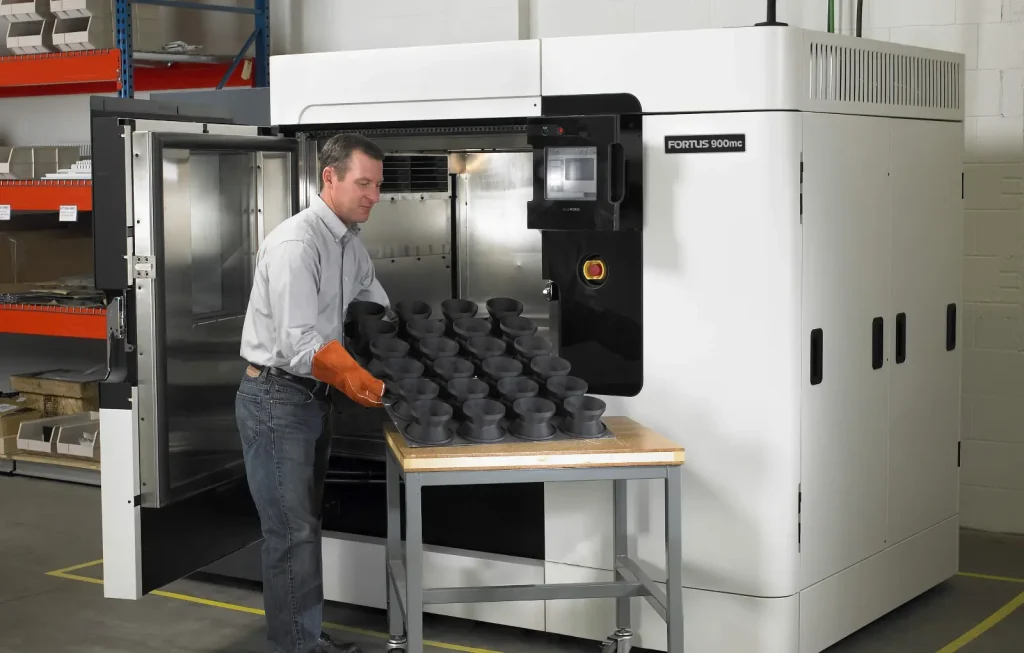
Stratasys F900 production 3D Printer
How TriMech Can Help
A 3D printer is just one piece of additive manufacturing, which is also just one fraction of the supply chain and business strategy of a company. But it takes more than a purchasing printer to ensure the successful integration of additive manufacturing.
We guide you to avoid pitfalls
Integrating a new technology is like a wilderness adventure.
The market is vast and choosing a technology to invest in can be scary, with a lot of pitfalls out there. Usually, when embarking on a trek you will take a guide to help keep you on track.
Additive manufacturing is not just about the 3D printer – you need expertise to design for it, guide it, and fully embody the entire process.
And that’s why we are here, as the right partner and expertise to address all elements of the continuum and support the entire process, including hardware, software, training, solutions, and services.
We help you validate the investment
Sometimes cost, time, or material is not the most important factor in purchasing an industrial 3D printer. To ensure success, it requires buy-in amongst the users of the machine and willingness to adopt and leverage the technology.
TriMech has assisted many companies implement additive manufacturing. On one occasion a large auto company client had a major roadblock, but it wasn’t budget or time, it was uncertainty from staff on the production floor. In order to prove out that a printer was the right solution, TriMech provided printed parts of the 3D printed tools so that the end users had tangible results to validate.
We help you evaluate your strategy
The right 3D printer or scanner should strengthen your entire business strategy and align with strategic, financial, and operational impact. We help you evaluate the following questions:
- What is the payback period and ROI?
- How will it affect overall throughput, labor reduction, and yield improvements?
- Will it scale with future production needs?
- Will the technology evolve as materials and software improve?
- Does this investment advance your goals – speed to market, tighter tolerances, etc.?

Additive Manufacturing Tooling 3D Engineering, supply chain resilience
Conclusion
Every business requires a unique solution that is usually a combination of in-house and outsourced services, and that’s why TriMech has a lot of customers that have a fleet of printers from us, and still also buy a lot of services.
You can mitigate the risk of capital investment by working with our services team first, to validate your applications and ROI, while eliminating variables such as capital cost, lack of design expertise and operators.
If you’re evaluating onboarding additive manufacturing in your workflow, contact our team to have a comprehensive, balanced view.

Written by Sophie Jin
Sophie (Huiyu) Jin is an SEO/PPC Specialist at TriMech, where she focuses on digital marketing strategies for their additive manufacturing and CAD business units.
Prior to joining TriMech, Sophie worked as a business journalist both in Canada and China, covering various industries, particularly tech companies.
Related TriMech Solution
Learn more about the solutions featured in this Article:
Need a Quote for Advanced Manufacturing?
Contact a TriMech manufacturing expert today and get answers to your questions
Related Content
More advanced manufacturing content from the TriMech team