




Aluminum vs Plastic: Which Material is Best for Your Manufacturing Project?

In manufacturing environments ranging from small machine shops to large aerospace facilities, aluminum has long been the go-to choice for custom fixtures, jigs, equipment, and assembly tools. The most common reason given when asked about material choice is simply “it’s what we have always used,” or “it’s what the toolroom prefers to work with.”
However, when we dig deeper, we usually hear “aluminum is more than strong enough.” In many cases, though, the application doesn’t come close to requiring aluminum’s high tensile strength. There is a wide variety of materials available other than aluminum that may be better suited to the task.
In this article, we’re going to take a look at how 3D printed polymers stack up against aluminum. By comparing aluminum vs plastic, particularly 3D printed polymers, we might find new possibilities that can save time, reduce costs, and improve performance.
Application First, Material Selection Second
Material choice should begin with a thorough understanding of the application. The big question to ask ourselves when looking to manufacture any part is “what is the application?”
- How will this part be used?
- What stresses will it be subjected to?
- What are key properties needed for the part to be successful?
- Are weight reduction, chemical resistance, or electrical insulation important?
These questions guide whether aluminum or plastics provide the best fit.
Aluminum is prized for its strength and machinability, but polymers offer advantages such as lower weight, corrosion resistance, and ease of manufacturing — especially when 3D printing are used.
Aluminum vs Plastic: Key Properties Comparison
Tensile Strength
It’s true, aluminum can outperform the strongest polymers and composites in some applications, but do you need that level of strength?
For example, a carbon fiber filled nylon like Stratasys Nylon12CF has a tensile strength of roughly 11,000 PSI (76MPa) but is half the density of aluminum.
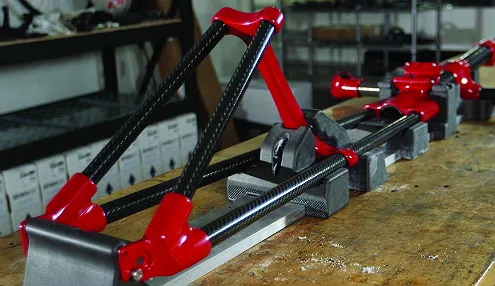
Stratasys Nylon12CF
If strength is a key factor, metal is the material of choice. However, if pairing strength with weight reduction or ease of manufacturing, then the needle may start to move towards the polymer side of things – even with a strength requirement leading the charge.
Anti-Static/Static Dissipative
Common practice in the electronics and aerospace industries is to make metal tooling and goods static dissipative. This usually involves costly coatings and plating operations, which makes it cost-prohibitive and time-consuming to produce uncommonly machined metals.
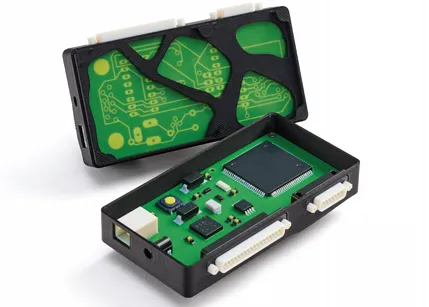
Antero
Several polymers are custom designed for static dissipative properties by using fillers like carbon-nanotubes mixed into their resins, such as PEKK Antero 840CN03. Materials like this are also formulated to have extremely high heat/chemical resistance and exceptional strength characteristics, providing a high strength solution that does not require additional coating or plating processes.
Electrical Insulated
Without additional coatings, metal is problematic when there are concerns of electrical conductivity. Perhaps there is an electrolysis worry or an arcing hazard.
Polymers, when not carbon loaded, are natural insulators. This allows for polymer tooling to excel in applications where there are concerns of equipment and worker safety in electrical operations.
Lightweight
Even compared to aluminum, polymers are lightweight solutions. If weight reduction is a project requirement, then high performance plastics like ULTEM, Antero (PEKK), and carbon fiber reinforced nylons (Nylon12CF) are perfect places to start.
3D printed polymers can still provide a time and cost savings to your project. Materials like ULTEM1010, favored for its high thermal resistance, low coefficient of thermal expansion, and high rigidity are the perfect solution for producing composite layup tooling. These high-performance polymer tools offer greatly reduced tool weight (easier to handle), allow for faster cooldown between lay-up cycles (faster throughput on serial production of composite parts), and are generally more economical and faster to produce than traditional CNC aluminum tooling.
If the stiffness-to-weight ratio of these polymers isn’t sufficient, composites might be necessary.
High Heat Tolerance
If extreme heat tolerance is your thing, then metal is the way to go. However, if you are producing a part that is continually subjected to temperatures at or below 300 degrees F, there is a good portfolio of polymers that can thrive in those environments (such as ULTEM, PEKK Antero, and PPSF).
Low Thermal Conductivity
While talking about heat, polymers are also poor conductors of heat. This is bad if you are trying to make a heatsink, but a great advantage if you are making tooling that needs to cool down rapidly or reduce the risk of a burn hazard to workers.
When making things like composite tooling or molds/patterns that require cooling before being ready to re-use, polymer tools might be a great solution to reduce your cycle times.
Chemical/Corrosion Resistance
Many stainless-steel alloys and nickel super alloys have great corrosion and chemical resistance. Unfortunately, the most common machining metals often have poor corrosion resistance.
Even the humblest of plastics, like ABS, have extremely high resistance to strong bases like sodium hydroxide, which will heavily corrode aluminum.
This isn’t to say that one plastic is a silver bullet against all chemicals, but different families of polymers have unique chemical makeups that promote resistance to their own unique group of chemicals. Be it strong acids, bases, ketones, or petroleum, there most likely is a 3D printable polymer that can hold up to your chemical needs.
Flexible/Impact Absorbing
Compared to metals, polymers have an upper hand when projects require impact absorbing properties. Various plastics like PC-ABS, Nylon, and TPU (thermoplastic urethane rubbers) excel at impact resistance, shock absorption, and acoustical/harmonic vibrations over metal.
Some 3D printing technology, like PolyJet, allow for multiple materials of different durometers to be produced simultaneously within one single part, opening the doors for new fixturing and inspection tooling applications.
Non-Marring/Low Surface Friction
Similar to impact and shock damping, many plastics like Nylon and Diran 410MF07 (Mineral filled Nylon 6,6) have extremely low surface friction and offer lubricating properties unlike their metal counterparts.
-
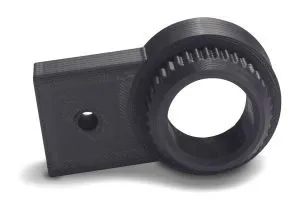
- Diran material spline tool
-
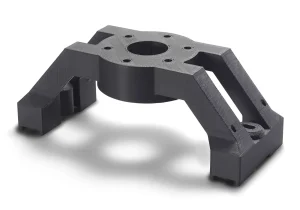
- Diran robot end
-
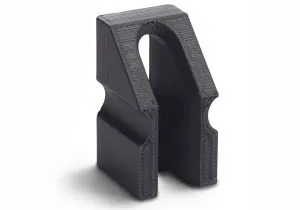
- Diran locator block
These polymers are great in fixturing and work holding applications where tooling contacts finished critical surfaces while still offering the strength and work-holding properties desired from metal fixturing.
Transparency/Color
Transparent, solid color, or full-color parts is not easily achieved without painting or powder coating. However, most 3D printable polymers on the market are available in a wide range of colors.
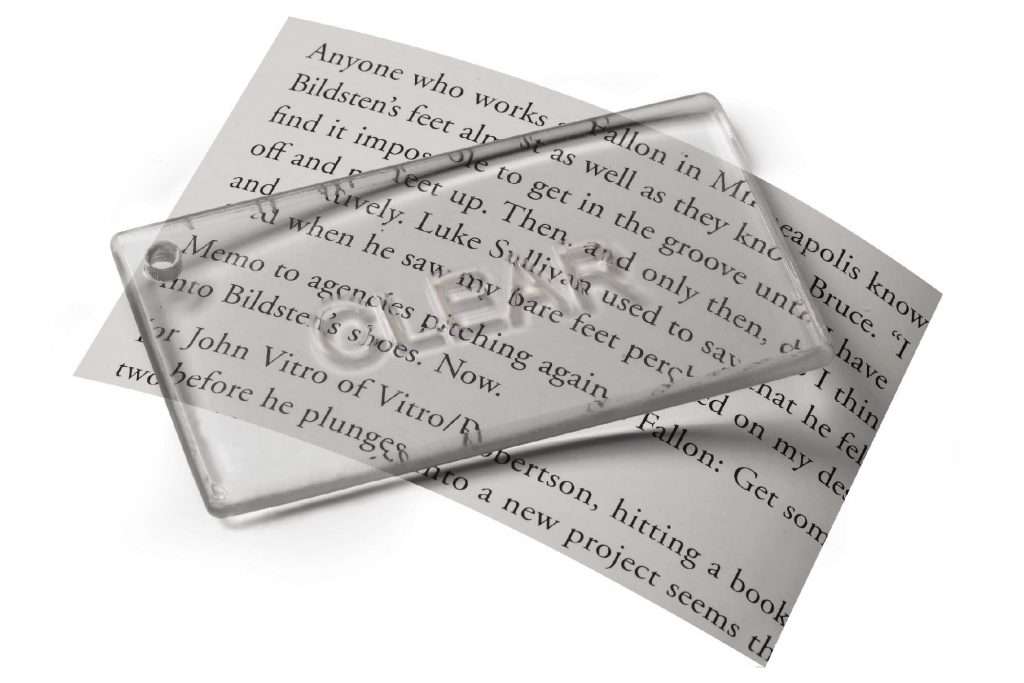
Transparent VeroClear
Some polymer 3D printing processes, like PolyJet, allow for full-color with text and images produced directly on final parts with no additional post processing. This can make marking and identifying fast and easy.
Ease of Manufacturing
While manufacturability is not necessarily a material property, it is certainly a major aspect to part production. Machining of traditional metals like aluminum, or machined plastics like acetal, require the presence of a machine operator to setup and oversee the machining operation.
This marks a key benefit of 3D printed polymer parts. They require no user interaction or oversight during the building process and only a few minutes to set up the job. Polymer 3D Printing is viewed as a lights-out operation, meaning that once the print is started, the user can simply leave the machine unattended for the duration of the process.
The secondary benefit of this style of manufacturing is the ability to produce extremely complex parts that exceed the capabilities of even 5-axis machining operations with little to no additional setup or manufacturing time.
Conclusion
Whether you decide to go with a machinable metal or 3D printed polymers, it’s important to take into consideration the purpose and expectations of your part. A deeper understanding can steer you in the right direction for the best material to use. There are benefits of both technologies but choosing the right one for the job will help you maintain quality while demonstrating time and cost-savings.

Written by TriMech Marketing
TriMech Manufacturing, a division of the global TriMech Group, is a strategic technology and business solutions paartner for designers, engineers, and manufacturers.
With a legacy spanning decades, the division focuses on helping clients design, build, and deliver products faster through a comprehensive ecosystem of manufacturing tools and expertise.
Related TriMech Solution
Learn more about the solutions featured in this Article:
Need a Quote for Advanced Manufacturing?
Contact a TriMech manufacturing expert today and get answers to your questions
Related Content
More advanced manufacturing content from the TriMech team