




Ultimate Guide for Carbon Fiber Material in 3D Printing

When thinking of strong, lightweight, and impact-resistant parts, carbon fiber material has increasingly become the choice, often associated with things like traditionally machined assembly jigs and fixtures, press brake tools, and even end-use components that are typically made of metals like aluminum and steel. In this article, we are going to review the differences in printable carbon fiber filled materials, the machines that can run them, and how these technologies are able to print these different carbon fiber composites, as well as tips for creating parts using carbon fiber filled materials.
What is Carbon Fiber Material in 3D Printing?
In 3D printing, the terms “carbon fiber material” and “carbon fiber-reinforced material” are used interchangeably, which can be confusing sometimes. In all cases, it refers to a type of composite blend that is a mix of a base polymer (typically ABS, Nylon, PLA, and PETG) and a reinforcing agent, of which Carbon Fiber is the most popular. Other reinforcing agents include glass, alumina, ceramic, and other less common options such as Kevlar, wood, cork, metal, etc.
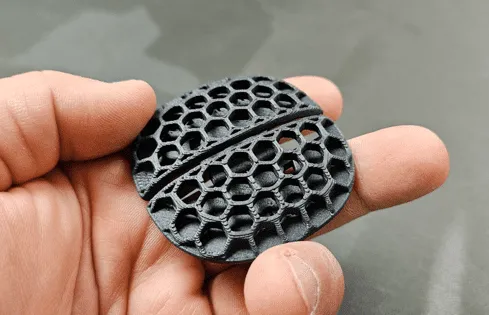
Similar to aluminum, carbon fiber blends are strong materials that are relatively light weight. This helps carbon fiber reinforcement stand out for its best in class strength-to-weight ratio, high stiffness, and durability among all the reinforcing materials. However, composites with reinforcing carbon fiber are also more expensive than their basic unfilled material alternatives.
If you prefer learning through visuals or audio, check out our webinar on Printing with Carbon Fiber Reinforced Material.
Download our How to 3D Print Tooling for Composites guide >>
Benefits of 3D Printing with Carbon Fiber
- Strength-to-Weight – A formidable tensile strength makes carbon fiber ideal for lightweight alternatives to metal parts such as robotic end effectors. This also makes carbon fiber a top choice for aerospace, automotive, manufacturing support, and high-performance engineering applications where both lightweight and high mechanical performance are required.
- Stiffness and dimensional stability – For applications that require parts hold their form with minimal flex, such as automotive brackets or inspection gauges, carbon fiber reinforced materials are amongst the best thermoplastic that exist.
- Heat Deflection – When exposed to heat other materials can deform under pressure. Nylon carbon fiber, like Nylon 12CF from Stratasys, a thermoplastic made from a blend of Nylon 12 filament and is 35% chopped carbon fiber by weight, has a Heat Deflection Temperature of 179°C at 66 psi.
Applications of Carbon Fiber 3D Printing
Due to these characteristics, carbon fiber filled materials are extensively used in the following industries:
- Automotive: Performance parts such as exhaust systems, air intake manifolds, and suspension brackets; interior components such as dashboards and trim parts.
- Aerospace: While the FAA(Federal Aviation Administration) has strict limitations on what can be used inside of the cabin of an aircraft (which is limited to Stratasys’s Ultem 9085 filament), carbon fiber filled thermoplastics are fantastic for aerospace assembly and inspection fixtures, drill guide jigs, metal stamping tools, waterjet holding fixtures, and even end-use drone frame components.
- Industrial manufacturing: Low-volume, high-performance end-use parts like gears, bearings, and custom tooling for jigs and fixtures.
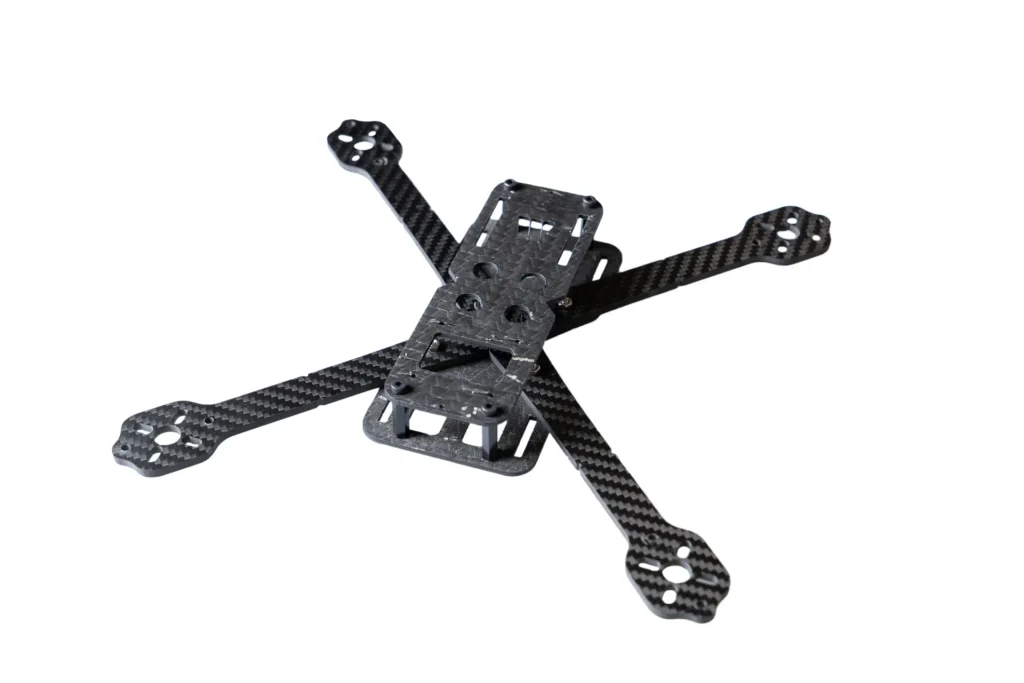
- Robotics: Print robot end of arm tools, drone frames.
- Athletic Protective Equipment: Bike components, helmets, skateboard and snowboard parts, etc.
Types of Carbon Fiber Material in 3D Printing
In 3D printing, carbon fiber materials are typically available in two forms: chopped carbon fiber and continuous carbon fiber.
Chopped carbon fiber
Chopped carbon fiber is carbon fiber material that is chopped into short fibers and mixed into a thermoplastic base. These fibers are generally a few millimeters long and are distributed evenly throughout the material.

Nylon CF 10 Soft Jaws Chopped Carbon Fiber Filament
Chopped carbon fiber-filled filament is compatible with many FDM printers. The carbon fiber-filled filament is melted and extruded through a single nozzle, depositing material layer by layer.
In the case of Stratasys printers, an independent support material using a second nozzle is utilized to ensure great surface finish and geometric accuracy on all sides of the part. These Stratasys FDM printers utilize soluble support options for easy and complex geometries. For Nylon CF10, they also include a secondary manual support removal option which is great for simple geometries. If you have experience with Carbon Fiber FDM materials, you’ll know just how challenging it can be to remove supports that are built in the same model material. Removing the support often leads to a rough surface finish or breaking delicate features of the part.
In addition to FDM printing, SLS printers can also print with powder that has been reinforced with powdered, using a laser that fuses the binding thermoplastic (typically Nylon) and carbon fiber powder and creating layers that build up the part.
Continuous carbon fiber
Continuous carbon fiber involves long, unbroken fibers of carbon embedded within a thermoplastic matrix. These fibers can run the entire length of the part if chosen in the build setup and can offer superior mechanical properties compared to chopped fiber composites.
Unlike chopped carbon fiber-filled filament, continuous carbon fiber is not mixed with the filament in the same way. In the Continuous Fiber Fabrication (CFF) process coined by Markforged, continuous strands of carbon fiber are fed separately into the printer alongside the thermoplastic filament. A specialized printer with two nozzles is required – one for depositing thermoplastic filament, one for inlaying continuous carbon fiber. The two materials are compressed and bonded together, but since the second nozzle is dedicated to the continuous fiber, this means there is no independent support material, which causes rough underside surfaces and makes the support removal process frustrating and difficult.
There is no doubt that the right part using the right amount of continuous carbon fiber inside can be stronger than chopped carbon fiber, but it will also be 4 to 5 times the cost as carbon fiber strand is expensive when compared to any 3D printed material. Also, critically important, the nozzle and material are incapable of printing and filling thin and small features and can only be laid down in select regions of the part (typically thicker regions), relatively spaced out, so continuous carbon fiber parts can never be entirely carbon filled throughout.
Chopped carbon fiber vs Continuous carbon fiber
Below is a quick comparison between chopped carbon fiber and continuous carbon fiber in 3D printing, mainly about their processing methods, pros and cons, and applications.
| Chopped carbon fiber | Continuous carbon fiber | |
|---|---|---|
| 3D Printing Technology | Filament with FDM, Powder with SLS | Filament with FFF |
| Advantages |
|
|
| Disadvantages |
|
|
| Applications |
|
|
Carbon Fiber Material for 3D Printing: Which to Choose?
Powder or filament?
Carbon fiber-reinforced powder generally contains smaller carbon fibers than filament, which means more even distribution throughout the printed part with near net isotropic properties (same mechanical properties in all directions). Processed through SLS technology, finer powder particles with shorter fibers also contribute to better dimensional stability, more intricate and complex shapes with high precision.
When compared to longer or continuous fibers used in extrusion-based technologies, powder with shorter fibers generally provides less strength improvements. As carbon fibers tend to align along the print direction during FDM extrusion and may interfere with the fusion between layers, filament often results in parts with higher strength along the print direction though potentially weaker interlayer bonding.
In general, powder is better suited for complex geometries and parts requiring high precision, while filament is often used for functional prototypes and end-use parts that are larger and chunkier, as these process also are less prone to print issues due to thermal fluctuation in printing and cooling, which can occur in powdered printing processes.
Nylon 11 CF powder printed parts
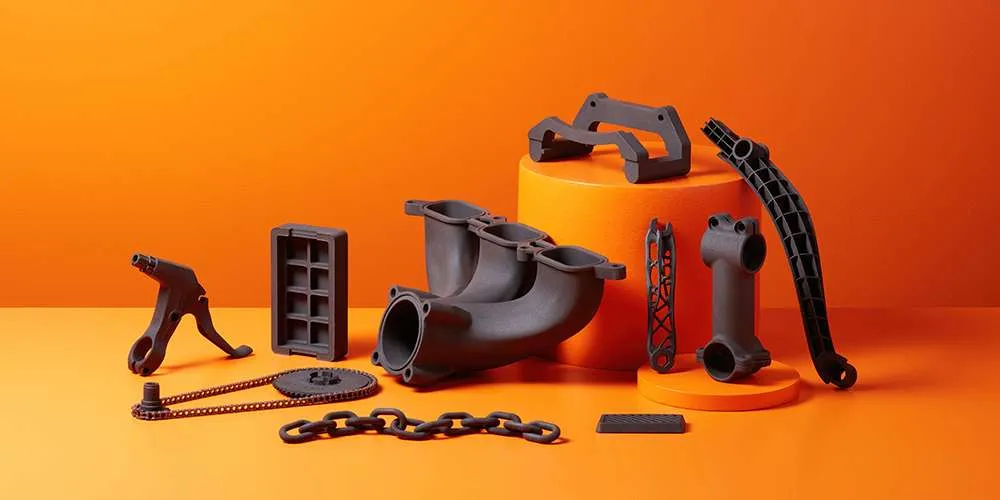
Nylon 11 CF powder is a high-performing carbon fiber-filled material compatible with the Fuse 1+ 30W SLS printer. It is for parts that need to be smooth, accurate, strong, lightweight and stable over time, even at elevated temperatures. One important note is that printing in Nylon 11 CF requires an inert environment, so the build environment requires nitrogen infiltration during printing to prevent oxidation from occurring, making this a bit more complicated to implement than the FDM/FFF alternatives.
Which filament to choose?
Different carbon fiber-reinforced materials offer different properties and thus are applied in various industries.
Carbon fiber reinforced Nylon
Best for: Strong, durable, lightweight parts with high wear resistance
Properties and Applications:
- With good strength and stiffness, it is suitable for functional prototypes, tooling and mechanical components.
- With high heat resistance, impact resistance and fatigue resistance, it is ideal for moving parts or high-performance applications that require durability.
Products:
- Nylon-CF10: With 10% chopped carbon fiber by weight, it enhances the material’s strength and rigidity. Typical applications include metal forming dies, press brakes, end effectors, soft jaws, alignment and assembly fixtures, clamping tools, and drill guides. Nylon-CF10 stands out due to the balance of strength, weight and cost.
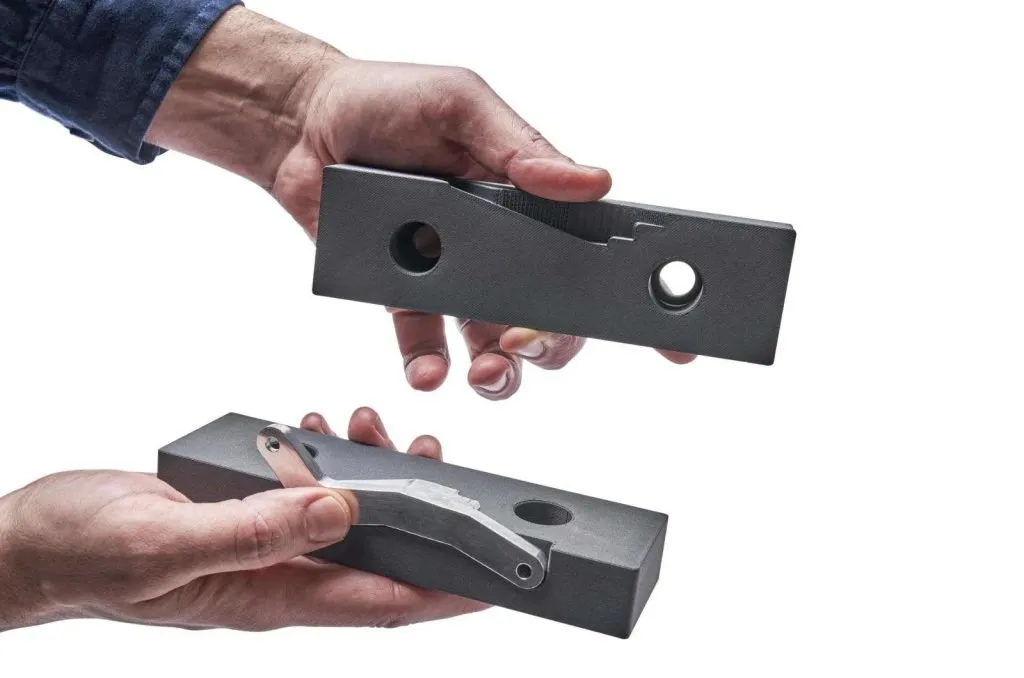
FDM Nylon CF10 Soft Jaw
- Nylon 12CF: one of our strongest thermoplastics, comprised of a blend of Nylon 12 resin and chopped carbon fiber, at a loading of 35% by weight. It has the highest flexural strength of any FDM thermoplastic, resulting in the highest stiffness-to-weight ratio. Appropriate uses include strong but lightweight tooling applications and functional prototypes in the aerospace, automotive, industrial and recreational manufacturing industries.
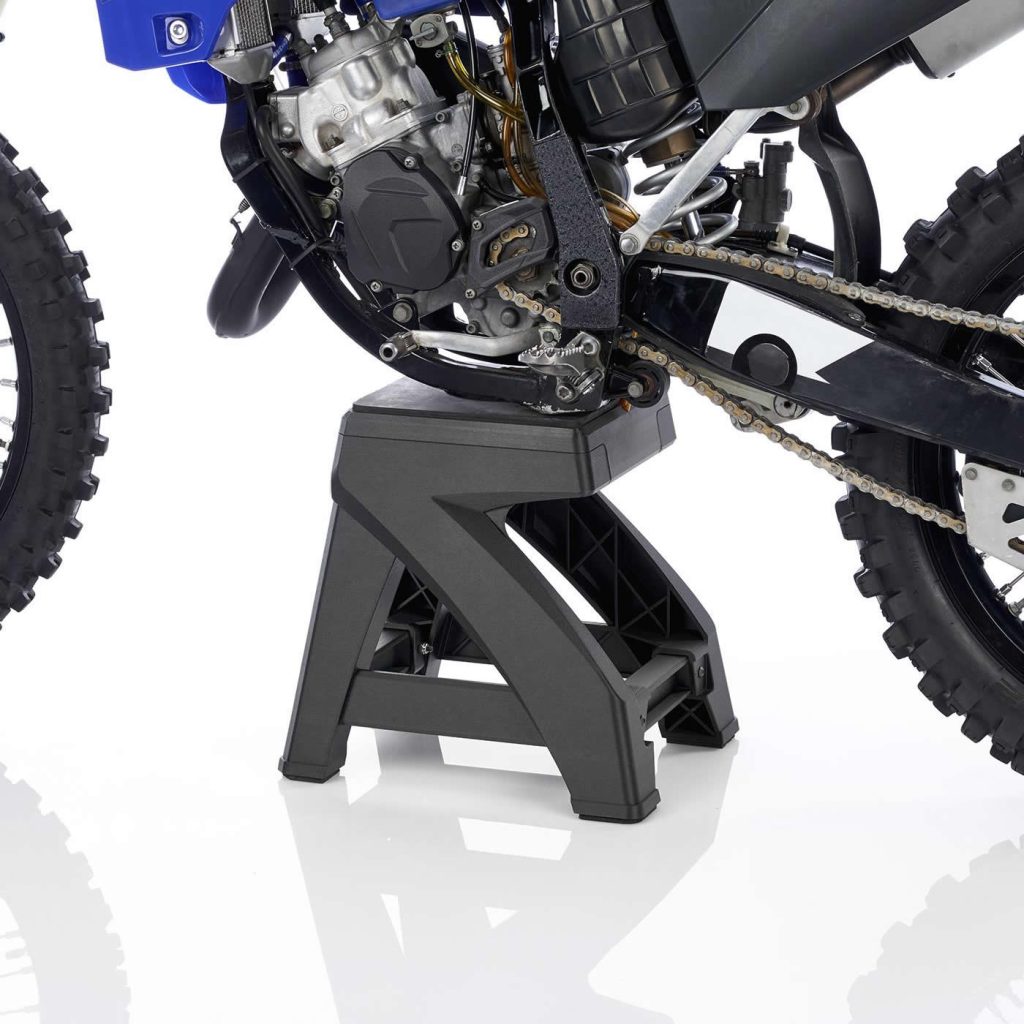
FDM Nylon 12CF bike stand
Carbon fiber reinforced ABS
Best for: Impact-resistant, high-strength parts that can tolerate moderate heat
Properties and Applications:
- Good mechanical properties with impact resistance for automotive parts, prototypes, consumer goods, toys
- Suitable for medium-strength applications that do not require extreme heat resistance
- Easier to post-process compared to some other materials
Products:
- ABS-CF10: With 10% chopped carbon fiber by weight, it is 50% stiffer and 15% stronger than standard ABS 3D printing material. Typical applications include manufacturing tools, jigs, fixtures and end effectors that benefit from the combination of increased stiffness and reduced weight.
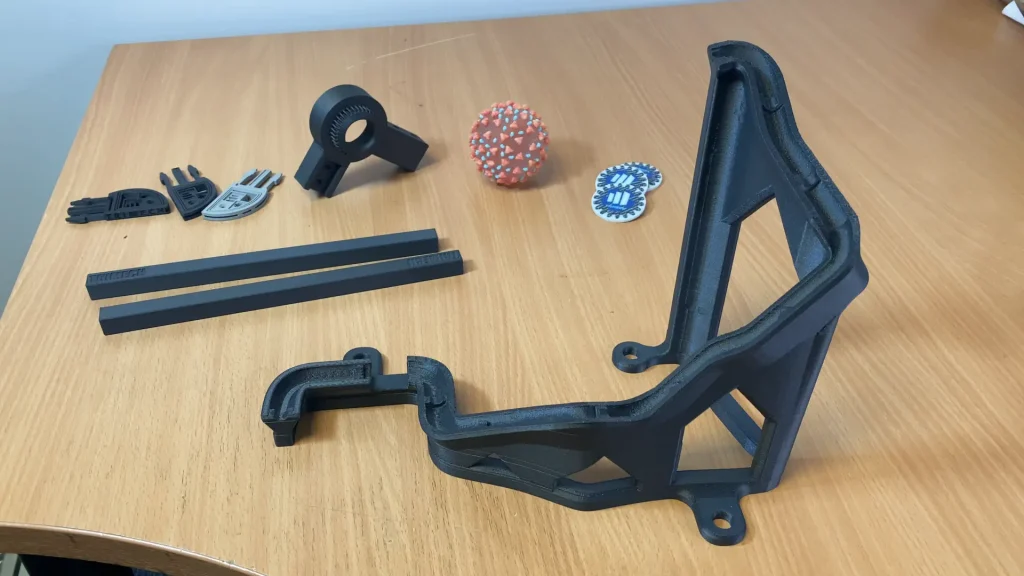
Stratasys ABS-CF10 material
Carbon fiber reinforced PLA
Best for: low-cost, lightweight parts that don’t need extreme durability or heat resistance, commonly used for decorative parts and prototypes.
Properties and Applications:
- Easy to print with compared to other carbon fiber filaments
- Low warping and good surface finish
- Relatively low mechanical properties
Carbon fiber reinforced PETG
Best for: Durable parts with good impact resistance and ease of printing
Properties and Applications:
- Good strength-to-weight ratio and excellent impact resistance, suitable for outdoor equipment and consumer products
- Better heat resistance than PLA but lower than ABS and Nylon
Carbon fiber reinforced ULTEM
Best for: High-performance applications in industries like aerospace, automotive, medical, and industrial manufacturing where lightweight, high-strength, and high-thermal stability materials are crucial
Properties and Applications:
- Great strength and stiffness while being lightweight
- Thermal stability that can withstand temperatures up to 170-200°C
Carbon fiber reinforced PEEK
Best for: High-performance, high-temperature applications that require exceptional strength and durability such as aerospace, automotive, and industrial manufacturing
Properties and Applications:
- Excellent strength-to-weight ratio with exceptional mechanical strength
- Thermal stability that can withstand temperatures up to 250°C+
- Chemical resistance, low friction, and excellent fatigue resistance
Carbon Fiber-filled Filament Product Comparison:
| ABS CF10 | Nylon CF10 | Nylon 12CF | |
|---|---|---|---|
| Layer Heights | .007”, .010”, .013” | .007”, .010”, .013” | .010″ using T20C on Fortus 450mc and F900, .020″ on F900 ONLY using T40C |
| Heat Deflection Temperature@264psi | 99 °C | 52 °C | 143 °C |
| Printhead Life | 700 hours for green head, 1500 hours for light grey head | 1500 hours | 650 cubic inches per tip |
| Printer | F170, F370, F190CR, F370CR | F190CR, F370CR | Fortus 450, F900 |
| Soluble Support Material | QSR | QSR, Sup4000B | SR-110 |
If you want to learn more about the differences between the Stratasys F370 and F370CR carbon fiber 3D printer, be sure to check out our comprehensive webinar on how to take advantage of the variety of applications and materials offered of these two printers.
Challenges of 3D Printing with Carbon Fiber Material
- Weak layer adhesion: Carbon fiber-filled materials can have poor bonding between layers. This anisotropic behavior (normally stronger within layer but weaker between layers) can complicate performance predictions, which is why the best base material for carbon filled blending is Nylon; this thermoplastic has the highest layer to layer adhesion of all thermoplastics, allowing for the best part strength in the Z direction.
- Warping and rough finish: When cooling quickly, carbon fiber filled materials have high internal stresses that can cause warping or curling, which is why a fully heated build chamber is critical to ensure optimal part flatness after printing. Excess carbon fibers in the filament can also result in a rough surface finish on the final product.
- Nozzle clogging and wear: The abrasive nature of carbon fibers can quickly wear out nozzles, especially those made of brass or copper.
- Extrusion problems: Carbon fiber materials are stiffer and more brittle than regular filaments, which can cause them to break or jam in the extruder. The filament can be more brittle and prone to breakage during printing, and be difficult to remove and fix depending on how the loss of extrusion occurs.
Tips for 3D Printing with Carbon Fiber Material
- Use hardened nozzle to prevent wear and clogging caused by abrasive carbon fibers. For continuous carbon fiber printing, use printers with specialized nozzles and fiber-cutting systems.
- Shorter fibers are generally easier to print with, allowing for smoother extrusion and reducing the risk of fiber clustering. But the choice between short and long carbon fibers depends on your specific application requirement.
- Regular nozzle maintenance: clean the nozzle with a brass wire brush or light abrasive pad; remove stubborn clogs with appropriate solvents.
- Optimize printing parameters for better layer adhesion: print slower, increase temperature and layer height. The Stratasys equipment maintains the optimal printing speed due to their rigorous material validation especially at 0.010” layers.
FAQ’s
What is the difference between chopped and continuous carbon fiber?
Chopped carbon fibers are short and randomly distributed within a composite material, while continuous carbon fibers are long strands that extend the entire length of the composite part, aligned in a constant direction. Continuous carbon fiber results in higher strength-to-weight ratio, but is more challenging to process, incapable of filling small thin features, and considerably more expensive than chopped carbon fiber.
Is a special 3D printer required for printing with carbon fiber material?
Certain features of a 3D printer are recommended to prevent fiber damage to components: hardened/abrasion-resistant extruder, a heated bed for first-layer adhesion (at a minimum; ideally a fully heated build chamber), and a high-temperature hot end.
How does carbon fiber compare to other composite materials?
When compared to other composite materials such as fiberglass and Kevlar-reinforced material, carbon fiber materials are generally stronger, stiffer, and lighter. It is higher in cost due to complex manufacturing and limited production.
Can I print functional parts with carbon fiber filaments?
Yes, carbon fiber-filled materials provide enhanced strength and stiffness compared to standard thermoplastics. Many can also offer better heat resistance and durability, which enables the printing of functional tests and end-use parts.
What support material is required for carbon fiber 3D printing?
When 3D printing with carbon fiber filament, support materials are essential for overhangs, bridges, or intricate designs that would otherwise collapse or fail during printing. For some carbon fiber-reinforced filaments, soluble support materials can be used. For example, Stratasys ABS-CF10 and Nylon-CF10 can be printed with soluble QSR support material. For Nylon 12 CF, the soluble material is SR-110. For Nylon CF, Stratasys also has a secondary support material for breakaway support printing in Sup4000b that works perfectly for flat parts with low complexity for fast turnaround to part in hand.
Conclusion
Carbon fiber 3D printing provides new opportunities for creating high-performance, lightweight, and durable parts across aerospace, automotive, robotics, and many other industries. While 3D printing with carbon fiber can present challenges, careful preparation and choosing the right material and equipment can yield outstanding results. Contact our experts if you have more questions.

Written by Sophie Jin
Sophie (Huiyu) Jin is an SEO/PPC Specialist at TriMech, where she focuses on digital marketing strategies for their additive manufacturing and CAD business units.
Prior to joining TriMech, Sophie worked as a business journalist both in Canada and China, covering various industries, particularly tech companies.
Related TriMech Solution
Learn more about the solutions featured in this Article:
Need a Quote for Advanced Manufacturing?
Contact a TriMech manufacturing expert today and get answers to your questions
Related Content
More advanced manufacturing content from the TriMech team